
Open Banking applied

Payment Initiation Service Provider (PISP)
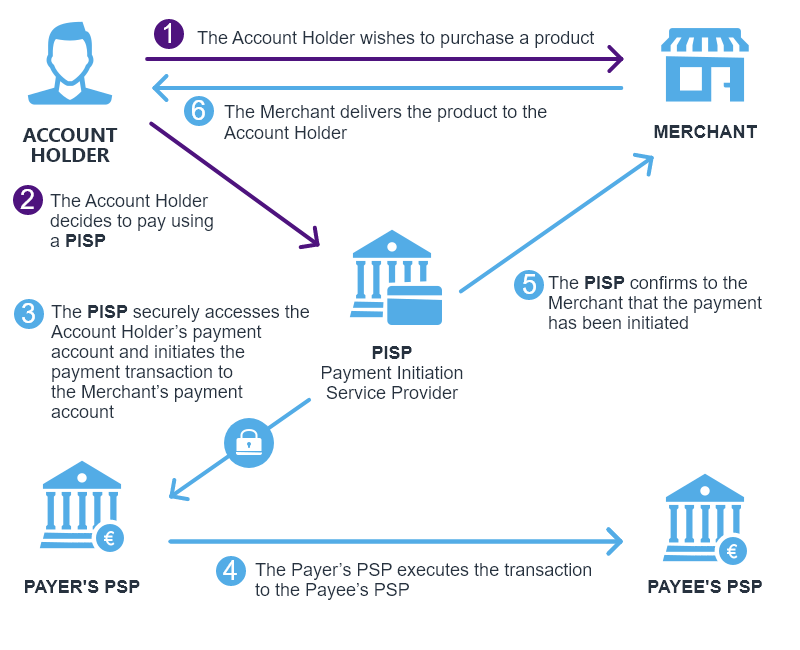
A payment initiation service provider or Payment Initiation Service Provider (PISP) can digitally initiate a payment from an account holder’s payments account to a recipient’s payments account. The account holder must first give their explicit digital consent to the PISP via internet banking or mobile banking.
- The PISP does not manage the payment amount and only initiates the payment on behalf of the user.
- Applications include paying invoices or deferred payment of an online purchase at the time of shipment, at the initiative of the invoicer or seller; the payer cannot then forget to give a payment order to their bank themselves.
- This method can serve as an alternative to existing online payment solutions and direct debits.
Account Information Service Provider (AISP)
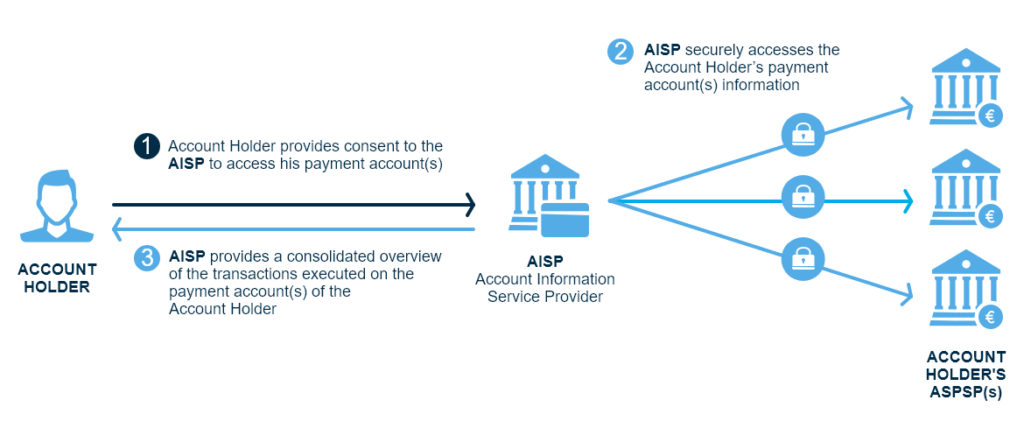
An account information service provider or Account Information Service Provider (AISP), again with the express consent of an account holder, gains insight into the transactions and balance of their accounts at a bank. This enables companies and institutions to develop smart financial services.
- Users can see their accounts at different banks in a single overview.
- Expenses can be automatically categorized in a digital household budget book.
- Someone applying for a loan does not have to collect all kinds of personal financial data and submit it to the loan provider; the applicant can simply give the loan provider digital access to his or her accounts at one or more banks.
SEPA Payment Account Access (SPAA)
The European SPAA scheme introduces innovative additional open banking services that go beyond PSD2. New possibilities include:
- Access to savings and credit card accounts.
- Initiating recurring and variable payments.
This expansion provides scope for more advanced financial services, while banks can receive a fee for offering these additional services. Led by the European Payments Council (EPC), banks and non-bank financial service providers are working together on this scheme.
In December 2024, the Journal of Payments Strategy & Systems published the article “The SEPA Payment Account Access scheme is driving Open Banking in the EU beyond the revised Payment Services Directive (PSD2)”, written by Niels Pranger (Dutch Payments Association) and Christophe Godefroi (EPC). The article describes the development, regulation, and the opportunities and challenges of the SPAA scheme.
The Dutch Payments Association is following the EPC’s SPAA scheme through its Open Banking Working Group.
Working together to ensure reliable open banking
-
Open Banking Working Group
The Open Banking Working Group ensures alignment and coordination within the Dutch open banking ecosystem. The working group monitors developments in legislation, standards and operational issues, thereby contributing to the secure and reliable use of open banking.