
Payments newsletter: Betaaljournaal 13
Towards the end of the year, it’s always a race against the clock. In the run-up to the festive season, there’s a lot of shopping taking place both online and in high-street shops, and we receive enquiries from various media outlets about transaction figures. There are also all sorts of meetings to round off the year properly and get everything in order for the new year. For example, the transition of Risk and Secure Banking is now fully complete. You can read more about this in this issue of Betaaljournaal.
I am looking forward to the new year, during which, amongst other things, we will be seeking a new chairperson for the board. Lex Hoogduin has stepped down as chairperson after more than four years. We owe Lex a great deal of thanks for his expert leadership during these dynamic times. Vice-chair Gerjoke Wilmink has agreed to take on the chairmanship on an interim basis.
I’ll conclude this foreword with a few appointments. Our very own Piet Mallekoote has been appointed by the ECB as a member of the Digital Euro Market Advisory Group. Among his fellow members will be Gerard Hartsink, former chair of the European Payments Council. Evelien Witlox, a member of our Advisory Board who has since stepped down, will also be bringing her expertise to the ECB. She will be leading the digital euro programme. I believe these appointments establish a strong link with the ECB! I hope you enjoy reading this and wish you a healthy 2022.
Gijs Boudewijn, Acting Managing Director

- Transition of Risk to the Dutch Banking Association
- Acceptgiro to be discontinued on 1 June 2023
- Review of the General Members’ Meeting
- Maestro debit cards to be phased out from mid-2023
- Instant Payments via TIPS to be more widely available across Europe
- TARGET XML migration in full swing
- Applied cryptography course another success!
- JPSS article on the payments sector in the Netherlands
- Debit card payments on Black Friday and Sinterklaas on a par with last year
- QR code scams
- Results of the National Forum on the Payment System meeting
- Figures
- Association news
- Agenda
Transition of Risk to the Dutch Banking Association

The Dutch Payments Association and the Dutch Banking Association (NVB) have decided, in consultation with their members, to consolidate their security-related tasks. This will enable an even more effective fight against fraud. In practical terms, this means that from 1 January 2022, all tasks will be brought under a single management structure at the NVB. The Safe Banking programme will also be transferred from the Dutch Payments Association to the NVB.
Consequently, the Risk team at the Dutch Payments Association will cease to exist, and most of the staff from that department will transfer to the NVB. These include Marco Doeland, Remco Ruiter, Oscar Covers and Laurens Messing. Following this transition, the Payments Association will remain responsible for a number of cyber security-related matters that specifically concern payment institutions. For further information, please contact Peter Kleppe:
The Risk team would like to thank all members for the fruitful collaboration on security matters within the Dutch Payments Association over the past few years and will continue this collaboration with full commitment from within the NVB, with a view to jointly achieving an even more effective approach to combating fraud!
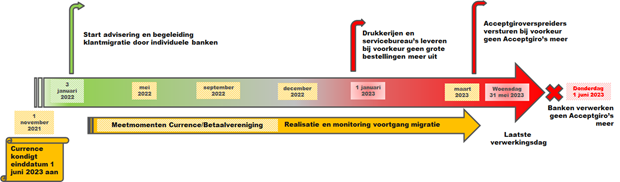
Acceptgiro to cease operations on 1 June 2023
Currence, the product owner of Acceptgiro , informed licence holders in November of the decision to discontinue Acceptgiro with effect from 1 June 2023. This decision has been explained in person to various stakeholders. The main reason is that Acceptgiro is being used less and less. In recent years, many Acceptgiro providers have already successfully switched to more efficient payment methods such as direct debits, mobile payment requests, invoices sent by email with a payment link, QR codes and the standard paper payment instruction. In addition, consumers are also using the paper Acceptgiro form less and less. Most Acceptgiro forms are thrown away, and payers are sending hand-signed Acceptgiro forms by post to their own bank with ever-decreasing frequency.
From January 2022, banks will assist the remaining Acceptgiro issuers in their transition to suitable alternatives. The National Forum on the Payment System (MOB) is contributing to this through its Accessibility and Availability Working Group.
Review of the Annual General Meeting
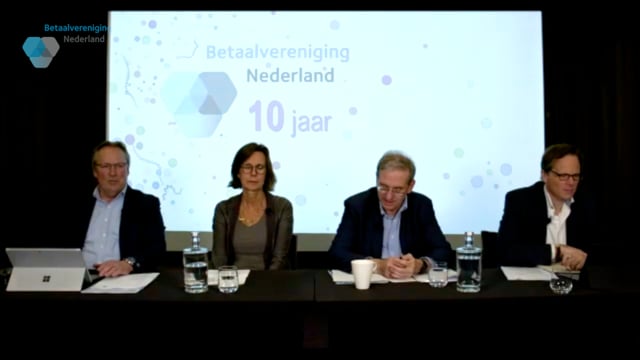
A festive edition of the Annual Conference had originally been planned for 18 November, but – due to the COVID-19 guidelines – it could not go ahead in the form envisaged. Instead, we organised a private online meeting for our members. The meeting consisted of two parts. The first part was the formal General Meeting of Members, whilst the second part focused on developments in payment systems over the past 10 years. Inge van Dijk (DNB) gave a presentation on this topic and reflected on the challenges that lie ahead. Miriam Osten (Dutch Payments Association) presented the results of a consumer survey. Gijs Boudewijn then led a panel discussion with Inge van Dijk, Kitty Koelemeijer (Nijenrode) and Suzan van Eeten (Rabobank). To our delight, around a hundred interested participants watched the event live. We have produced a video to give you an impression of the event.
This content is available after accepting the marketing cookies.
Maestro debit cards to be phased out from mid-2023
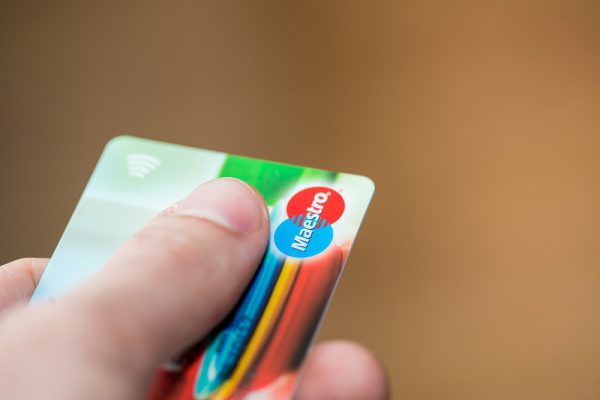
Mastercard has announced that, from 1 July 2023, banks will no longer issue new Maestro debit cards. From that date, Mastercard will replace the Maestro brand with Debit Mastercard. In the Netherlands, an increasing number of Debit Mastercard and Visa Debit cards will be issued in the coming years. In doing so, the Netherlands is following a global trend. Customers can already pay with the new cards at roughly half of all Dutch tills, for example in hotels, restaurants and places frequented by tourists. Shops where customers cannot yet pay with Visa Debit or Debit Mastercard will be able to enter into agreements with their bank or payment service provider over the coming year. All standard existing terminals require only a simple software update. Some outdated payment terminals will need to be replaced in order to accept the new debit cards. Read the full article .
Instant Payments via TIPS becoming more widely available in Europe

Just as in the Netherlands, initiatives have been developed across Europe to enable Instant Payments. These are all based on the same standard – the SEPA Instant Credit Transfer – but, for various reasons, are not yet interconnected. As a result, making an Instant Payment from the Netherlands to, for example, Spain is still only possible to a limited extent. To break this deadlock, the ECB Governing Council has decided that every bank participating in Instant Payments (over 60 per cent of banks in Europe) must connect to TARGET Instant Payments Settlement (TIPS) by December 2021. Through this system, payment service providers will then always be able to reach one another. As things stand, the process is set to continue until early 2022, but after that, an instant payment between different countries will, in principle, be just as straightforward as it is currently within the Netherlands.
Next steps
The European Commission regards Instant Payments as the new standard, offering an additional opportunity to compete with other international schemes. Instant Payments are also set to play a role within the European Payments Initiative (EPI), which has been welcomed by both the Commission and the ECB. In this context, it is important that even more banks start offering Instant Payments. The European Commission has indicated that an accelerated roll-out of Instant Payments may require legislation. It should become clear in the course of 2022 what measures will result from this. The Dutch Payments Association is monitoring these developments closely.
TARGET XML migration in full swing
Banks and other financial service providers are currently working intensively on the migration of high-value payments via TARGET2 to the ISO 20022 XML standard. This is being overseen by DNB. According to the overall schedule, development is largely complete and they are currently testing the connection to the TARGET infrastructure via the selected network providers.
The user testing phase began on 1 December, during which the banks are undergoing a mandatory testing programme. The banks have agreed to launch a joint testing programme in addition to these mandatory tests, which will test the entire chain, including aspects specific to the Netherlands such as the Switching Service .
Twenty-three banks are now participating in these “end-to-end tests”. Four test windows have been scheduled: the first window – involving around 10 banks – will start in early February 2022. The start of the subsequent windows is now scheduled for one month later each time.
The testing programme is being coordinated by the Dutch Payments Association and is intended, amongst other things, to ensure for its members that the “big bang migration to XML” for TARGET2 in December 2022 proceeds without a hitch.
Interested banks can still register via:
Applied Cryptography course another success!
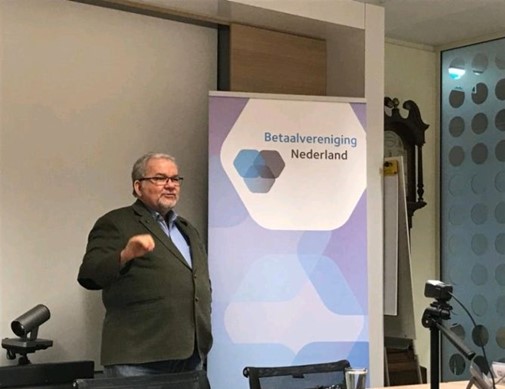
On Friday 19 November, the Applied Cryptography course concluded with a certificate presentation ceremony. This was followed by a talk by cryptography expert Philip R. Zimmermann for course participants and other interested parties.
Maarten van Wijk, Senior Information Security Adviser and one of the course organisers, introduced Phil Zimmermann and spoke about his time as a cryptographer. At the time, he received the floppy disc pictured here from a colleague. That disc was regarded as a weapon, as it contained a programme called Pretty Good Privacy, developed by Zimmermann. Since then, PGP has become increasingly accepted.
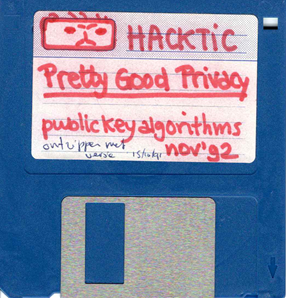
Zimmermann founded several companies with PGP as their core business. He was also involved in many innovative concepts, received various awards and has since been inducted into the Internet Hall of Fame for his outstanding contribution to privacy on the internet.
In his talk, Phil expressed his concern about the vulnerability of democracy, which could be undermined in a polarised society. Governments, but certainly also the algorithms of social media platforms – where consumers are increasingly bombarded with clickbait – can easily fuel this polarisation and lead people to believe in conspiracy theories. The course participants now understand better than anyone just how important cryptography is for our modern digital society.
JPSS article on the payments sector in the Netherlands
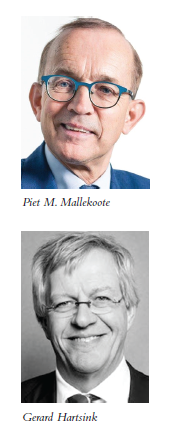
As previously announced, Piet Mallekoote and Gerard Hartsink have written an article on the payments sector in the Netherlands for the Journal for Payments Strategy and Systems (JPSS, volume 15, no. 3). The publisher has given permission to make this article available to our members free of charge. You can read the article here.
You may not want to miss out on the latest developments in the payments sector. Gerard Hartsink, JPSS editor: “I wholeheartedly recommend a subscription. You’ll be served up a wealth of new insights, case studies and topics currently being discussed in the world of payments on a silver platter.” You can subscribe to this journal via this link .
Debit card payments on Black Friday and Sinterklaas on a par with last year

The number of debit card payments at Dutch shop checkouts around Black Friday and Sinterklaas was similar this year to the same period last year. Compared with two years ago, before the pandemic, there were up to 20 per cent fewer daily debit card payments at the checkout during that period this year. We also know that the number of cash payments at shop checkouts has fallen sharply, by around 30 per cent. The busiest day for debit card payments was the Saturday following this year’s wet and cold Black Friday, with around 18.5 million debit card payments, representing an estimated turnover of 558 million euros. That is over 5% fewer debit card payments than on the same Saturday last year. Read the full article.
QR code scams
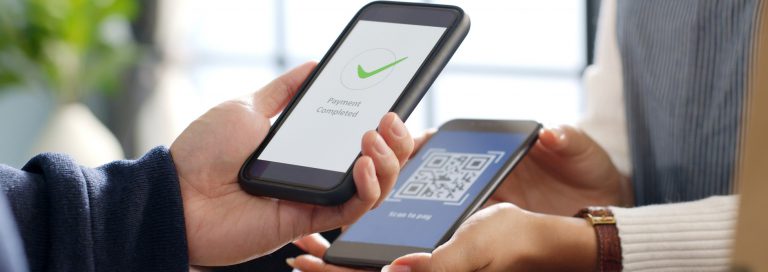
The police, the Fraud Helpdesk and various media outlets are warning against phishing and fraud involving QR codes. Criminals use two types of QR code scams:
- A person or company asks you to scan a generic (standard) QR code, using a random QR scanner or the standard camera on a smartphone or tablet. This QR code usually opens the web browser and may display a fake website, purporting to be from the bank or another well-known organisation, such as the Tax and Customs Administration or DigiD.
- An individual or company asks you to scan a special QR code using the mobile app of your bank or a payment service such as Tikkie. Through this QR code, the fraudster attempts to get the victim to make a payment or to gain direct access to your bank account.
Read the full article .
Results of the MOB meeting
At the MOB meeting on 25 November 2021, the following points, amongst others, were discussed:
- Status of the migration of cash and deposit machines to Geldmaat
The MOB was informed about the final phase of the migration of ABN AMRO, ING and Rabobank’s cash and deposit machines to Geldmaat. Since the lifting of the last lockdown at the start of the summer, the number of cash withdrawals has risen more than previously anticipated. Due to staff shortages at the cash-in-transit company, consumers and business owners have regularly experienced difficulties when withdrawing and depositing cash. A great deal of effort has been – and continues to be – put into resolving these issues. - Improving accessible and reachable payment services for vulnerable groups
The MOB has discussed the first interim report on the implementation of the action plan. It appears that good progress has been made. Discussions have taken place with various parties to gain a better understanding of the needs of vulnerable groups, with a view to improving the accessibility and availability of payment services for them. - Losses from bank helpdesk fraud alarmingly high
The MOB has noted with concern the increased losses resulting from bank helpdesk fraud and fraud involving requests for assistance. In the case of bank helpdesk fraud, the losses incurred in the first half of 2021 amounted to 16.5 million euros (full year 2020: 26.7 million euros). Losses due to ‘help request’ scams amounted to 8.3 million euros in the first half of 2021, whilst those due to phishing amounted to 6.1 million euros. - MOB takes note of the end date for Acceptgiro in mid-2023
The MOB has taken note of Currence’s announced decision to discontinue the Acceptgiro scheme with effect from 1 June 2023.
Figures
20.6 million debit card payments on the busiest debit card day of 2021 to date
405 million debit card payments in November 2021
Want more figures? Visit factsheet.betaalvereniging.nl
Association news


At the General Meeting of Members on 18 November, Prof. Lex Hoogduin stepped down as chair of the Dutch Payments Association’s board after more than four years in the role. Vice-Chair Gerjoke Wilmink will act as Chair and oversee the process of finding a new independent Chair. Board member Alexander Baas, representing de Volksbank, will be succeeded by Joyce van der Rest with effect from 1 January 2022.
Agenda
- 31 March 2022 – The future of payments. Members of the Dutch Payments Association receive a 20 per cent discount . Topics to be covered this year: Regulations – Reality, New payment behaviour, Acceleration towards cashless
- 19 May 2022 – Betaalvereniging Annual Conference
Members’ Bulletin
In addition to this Betaaljournaal, the Dutch Payments Association also publishes Member Bulletins. The bulletins are usually published a few times a month and focus on a specific theme. You may be a member but not yet receiving these bulletins. You can ask to be added to the mailing list via secretariaat@betaalvereniging.nl.
Subscribe to Payments newsletter
Are you also keen to find out about the latest developments in the payments sector? Stay up to date via the ‘Betaaljournaal’. You can subscribe here.
Related articles
-

BIC List Now Accessible
-
News
-
IBAN and BIC
-
-

BIC and Identifier “XTAFNL2A” Added to the SEPA BIC List
-
IBAN/BIC list
-
IBAN and BIC
-
-
Vote on the Design of New Euro Banknotes
-
News
-
Cash payments
-
-
BIC and Identifier ‘YABNNL22’ added to the SEPA BIC list
-
IBAN/BIC list
-
IBAN and BIC
-
-
BIC and Identifier ‘HLGTNL22’ added to the SEPA BIC list
-
IBAN/BIC list
-
IBAN and BIC
-
-
BIC and identifier ‘SNNNNL2A’ added to the SEPA BIC list
-
IBAN/BIC list
-
IBAN and BIC
-