
Lex Hoogduin’s speech marking the end of the Efficient Payments Foundation
Professor Lex Hoogduin, chair of the Board of the Dutch Payments Association, spoke at ‘The Final Round’, the closing conference of the Foundation for the Promotion of Efficient Payments.
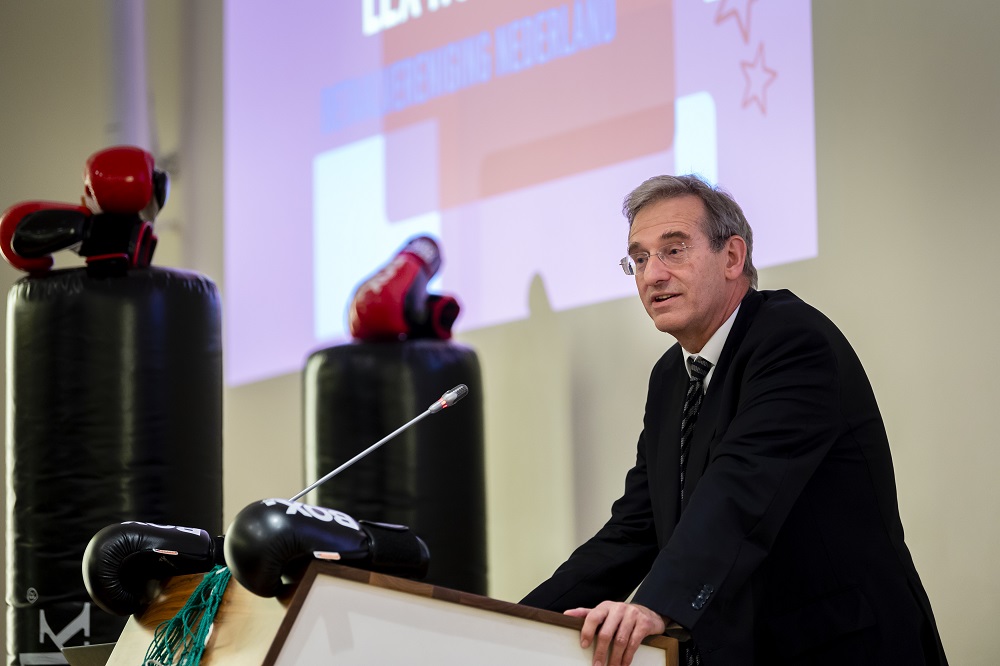
The Dutch Payments Association will take over the Foundation’s activities. Among other things, Hoogduin announced the new target: 75 per cent of point-of-sale payments to be made by debit card or smartphone in 2025.
Ladies and gentlemen,
It is a great pleasure to address you today. My name is Lex Hoogduin and I chair the Board of the Dutch Payments Association.
This is a special day: for payments in the Netherlands, for consumers and businesses, and for me personally. I will return to that.
Today we celebrate an organisation that is winding itself up because of its tremendous success, and the fact that constructive cooperation between all market participants leads to the best possible outcomes for society in point-of-sale payments. The central bank has, of course, played an active supporting role as a catalyst.
Let me begin with a few words about payments in the Netherlands. As you know, payments perform an important function in society. They are the circulation system of our economy. Without properly functioning payments, the economy cannot grow and flourish, and financial stability is put at risk.
Our payment system rightly enjoys an international reputation for being highly efficient, secure and reliable, as well as accessible. Everyone must be able to participate, or financial exclusion threatens. And all of this is achieved at relatively low cost to society.
We can therefore be proud of our payment system, although we Dutch sometimes find that rather uncomfortable. We prefer not to make a fuss. Do we really think we are better than others? Yes, for once we may say so, because our work is highly regarded abroad, including by European institutions such as the European Central Bank and the European Commission.
Ladies and gentlemen, cooperation is the foundation of our success. Within the Dutch Payments Association, payment service providers work together and with other stakeholders.
Our mission as the Dutch Payments Association is to ensure that payments remain secure, reliable, efficient and accessible. That is what we stand for, in close connection with our members, their customers and our stakeholders, many of whom are here today.
As I said, this is a special day, because we are discussing the resounding success of debit card payments at points of sale. That success has made point-of-sale payments more secure, more reliable and more efficient.
Security has improved, particularly for retailers, because the number of armed robberies at shops has fallen sharply as less cash is kept in tills. Reliability is now subject to a statutory availability standard of 99.88 per cent. The improvement in efficiency is clear from the fact that the total cost to a retailer of a contactless debit card payment has fallen to 15 cents, while a cash payment costs no less than 29 cents. Accessibility has also received attention, with proposals for an accessible payment terminal and a vision on cash.
There is, of course, another side to this success. Although we all want fewer cash payments—not ‘cashless’, but ‘less cash’—cash must remain available to those who need it. This includes vulnerable groups who struggle with technology and people with disabilities, as well as consumers who do not wish to pay electronically as a matter of principle. After all, cash remains the ultimate fallback option during major disruptions.
More than seven years ago, on 26 May 2011, I spoke at Retailpoort, an event organised by the Dutch Retail Council, in my capacity as a director of De Nederlandsche Bank and chair of the National Forum on the Payment System. That was almost six years after the 2005 Payments Covenant had been signed and two years after the Further Agreement to that Covenant.
The title of my presentation was: ‘The cashless shop: close at hand and without limits?’ I first explained the statutory task of De Nederlandsche Bank: to promote a reliable, secure, efficient and accessible payment system. That will sound familiar, and you will understand that I feel extremely comfortable in my new role at the Dutch Payments Association. It fits me like a glove, because, just like DNB, the Association is committed to secure, reliable, efficient and accessible payments.
It is fascinating to witness first-hand the extraordinary pace of change that characterises payments today and to help chart the course for the Dutch payments market. In that sense, I have come full circle on this special day.
But to the matter at hand. You will undoubtedly remember that more than 2.1 billion debit card payments were made in 2010. At the time, approximately 32 per cent of point-of-sale payments were made by debit card. We did not yet know exactly where this would lead—and, for that matter, we still do not.
I concluded my speech at Retailpoort with the following words: ‘Pursuing social efficiency in payments and promoting the new way of paying by debit card are both sensible and logical. Guided by the four principles of payments, market participants can responsibly move towards less cash in shops. The cashless shop will certainly come closer in this way, but there are limits.’
The parties to the Covenant redrew those limits in the second Further Agreement in 2014. Their aim was to move from 40 per cent debit card and 60 per cent cash payments to 60 per cent debit card and 40 per cent cash payments by the end of 2018. The halfway point—50 per cent each—was reached as early as 2015, and the joint target set by banks and retail organisations has been comfortably exceeded. More than 61 per cent of all payments are now made by debit card.
The cashless shop has therefore indeed come closer, but it is still quite some distance away. The contactless shop, on the other hand, is already here. Contactless debit card payments have grown enormously in recent years. Consumers choose convenience, and more than half of all debit card payments are now contactless, using debit cards and, increasingly, smartphones.
And yes, there are of course cashless shops on a limited scale. You will all know examples such as Grape District, Marqt and De Pizzabakkers. Caution is still needed, because emotions can run high when a retailer—or a municipality—decides no longer to accept cash, however understandable that may sometimes be, particularly from a security perspective. Fortunately, we have considered this issue in the Netherlands: the National Forum on the Payment System’s 2015 vision on cash explains how we should deal with it prudently.
Ladies and gentlemen, together we will make more than four billion debit card payments this year. What happens after 2018? After all, the Foundation for the Promotion of Efficient Payments, which helped make all this possible, is winding itself up.
A victim of its own success? No, this was planned. The targets have been achieved and the mission accomplished. Will everything happen automatically from now on, you may wonder? Not entirely, although consumer behaviour does appear to be moving almost of its own accord towards even more electronic—and contactless—payments.
The parties to the Covenant—banks and retail organisations—have formulated a new target on the road towards the cashless shop, a new point on the horizon. Their aim is for 75 per cent of all point-of-sale payments to be made by debit card or smartphone in 2025, with well over half of those being contactless.
That is the new joint target. Naturally, it does not lose sight of the needs of vulnerable groups who will continue to require cash. To meet that need at the lowest possible cost, the banks have been working together for several years through Geldservice Nederland (GSN).
Having first brought cash-counting centres under joint operation, the banks decided that the next step towards greater efficiency would be to transfer all ATMs to GSN. This cooperation allows the banks to continue providing comprehensive access to cash at acceptable cost for as long as, and wherever, it is needed.
To make the new target of 75 per cent debit card payments possible, we must of course continue to cherish the principles of the Foundation for the Promotion of Efficient Payments and jointly carry out efficiency projects, including after 2018. The Foundation’s legacy—which sounds rather dramatic, because it is very much alive—will therefore be entrusted to the Dutch Payments Association.
I can assure you that we are extremely proud of this and grateful for the trust placed in us. The Dutch Payments Association will do everything it can to achieve the new target responsibly, taking account of the interests of everyone involved. Our successful cooperation will therefore continue, and I have no doubt that this target too will be achieved.
Ladies and gentlemen, I will conclude. Seven years ago, I asked whether the cashless shop was close at hand and whether there were limits. Well, the cashless shop is indeed coming ever closer, but there certainly are limits. Where exactly do those limits lie? Time will tell. For now, our target is 75 per cent debit card payments in 2025. That is another seven years from now, and I hope to be able to tell you then whether we have achieved our new goal.
Related articles
-
Dutch abroad pay most with cards in Spanish hospitality
-
News
-
Card payments
-
-

High confidence in Dutch payment system
-
News
-
Card payments
-
-
Checking In and Out on Public Transportation Is Now Even Smoother with Your Smartphone
-
News
-
Card payments
-
-
More travelers very satisfied about traveling with payment card
-
Press release
-
Card payments
-
-
Six out of ten retail business owners say they are prepared for card payments failures
-
News
-
Card payments
-
-
Make sure you have (digital) fallback options in case of a potential card payments failure!
-
News
-
Card payments
-