
Online consumer spending rises, driven mainly by surge in holiday bookings
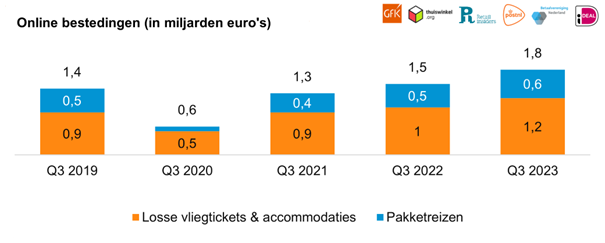
Online consumer spending increased in the third quarter of 2023 compared with Q3 2022. Dutch consumers spent a total of €7.44 billion online in Q3 2023, 4% more than in Q3 2022. This growth was driven by a 16% increase in online spending on services, boosted by growth in package holidays (+32%) and individual airline tickets and accommodation (+20%). The total number of online purchases was 81.7 million, remaining relatively stable compared with the third quarter of 2022 (+1%). Of all consumer spending, 29% took place online, while 11% of all purchases were made online. These findings come from the latest Thuiswinkel Markt Monitor, the study of online consumer spending in the Netherlands. GfK conducts the study on behalf of Thuiswinkel.org and co-commissioner Retail Insiders, in cooperation with PostNL, the Dutch Payments Association and Currence.

In Q3 last year, online spending on package holidays and on individual airline tickets and accommodation was still comparable with 2019, the final year before COVID-19. In 2023, online spending in these categories rose by an average of 24%. This increase can be explained by a sharp rise in bookings in September, particularly last-minute bookings for the autumn holidays.
Spending on package holidays is also increasingly shifting online rather than taking place through physical channels. In Q3 2022, 78% of spending on package holidays was online; by Q3 2023, this had risen to 85%. Individual airline tickets and accommodation are purchased online in 90% of cases. Marlene ten Ham, managing director of Thuiswinkel.org, said: “We book most of our trips online. Online spending on travel is rising faster than the number of online travel purchases, which grew by an average of 6%. This may be due to inflation, but it may also be because people are choosing more expensive trips than before.”
We buy more for less
Online spending on products decreased slightly (-2%), while the number of products ordered online remained stable. The total number of online purchases was 81.7 million, which was relatively unchanged compared with the third quarter of 2022 (+1%). Categories with lower online spending this quarter included Clothing (-13% compared with 2022), Consumer Electronics (-5%) and Telecom (-5%). Online spending on Media & Entertainment increased by 13%, mainly due to sales of games and gaming accessories.
Cross-border spending increases
Online cross-border spending increased by 10% compared with the third quarter of 2022. This was mainly due to a 17% rise in spending on services, again driven by spending abroad on package holidays (+28%) and individual airline tickets and accommodation (+19%). “Of online spending on individual airline tickets and accommodation, 29% takes place abroad. The figure for package holidays is 11%,” Ten Ham said. “Holiday spending is increasing within Europe, including in Germany and the United Kingdom, which accounted for 20% and 9% respectively of cross-border holiday spending in Q3 2023. Travel spending outside Europe is also increasing, including spending in the United States, which rose by 51% in Q3 2023.”
Online cross-border spending on products also increased slightly (+3%), as did the number of cross-border product purchases (+10%). Major growth segments included toys (+66% in spending) and clothing (+23% in spending).
iDEAL grows as smartphones become more popular
iDEAL remained by far the most widely used payment method for online purchases, and its share increased further. The share of online purchases paid for using iDEAL rose from 69% in Q3 2022 to 73% in Q3 2023. This increase was driven by iDEAL’s growing share of online spending carried out using a smartphone.
In the third quarter of 2023, 88% of Dutch people aged 15 and over made an online purchase, a share comparable with the previous year. The proportion of online shoppers using a smartphone to make purchases increased again. Smartphones now account for 27% of online spending, two percentage points more than last year, and 35% of the number of purchases, one percentage point more than last year. This increase came mainly at the expense of tablet use.
Related articles
-

Pay-by-Bank, what is it?
-
News
-
Online payments
-
-
A2A payments continue to grow
-
News
-
Online payments
-
-
Dutch abroad pay most with cards in Spanish hospitality
-
News
-
Card payments
-
-

High confidence in Dutch payment system
-
News
-
Card payments
-
-
Next Phase of iDEAL Migration to Wero Begins in October
-
News
-
Online payments
-
-

Lower travel spending is putting pressure on overall online spending
-
News
-
Online payments
-