
Milestone: more than half of online shoppers use a smartphone
The e-commerce market has accelerated dramatically, and that growth showed no sign of ending in the first half of 2021.
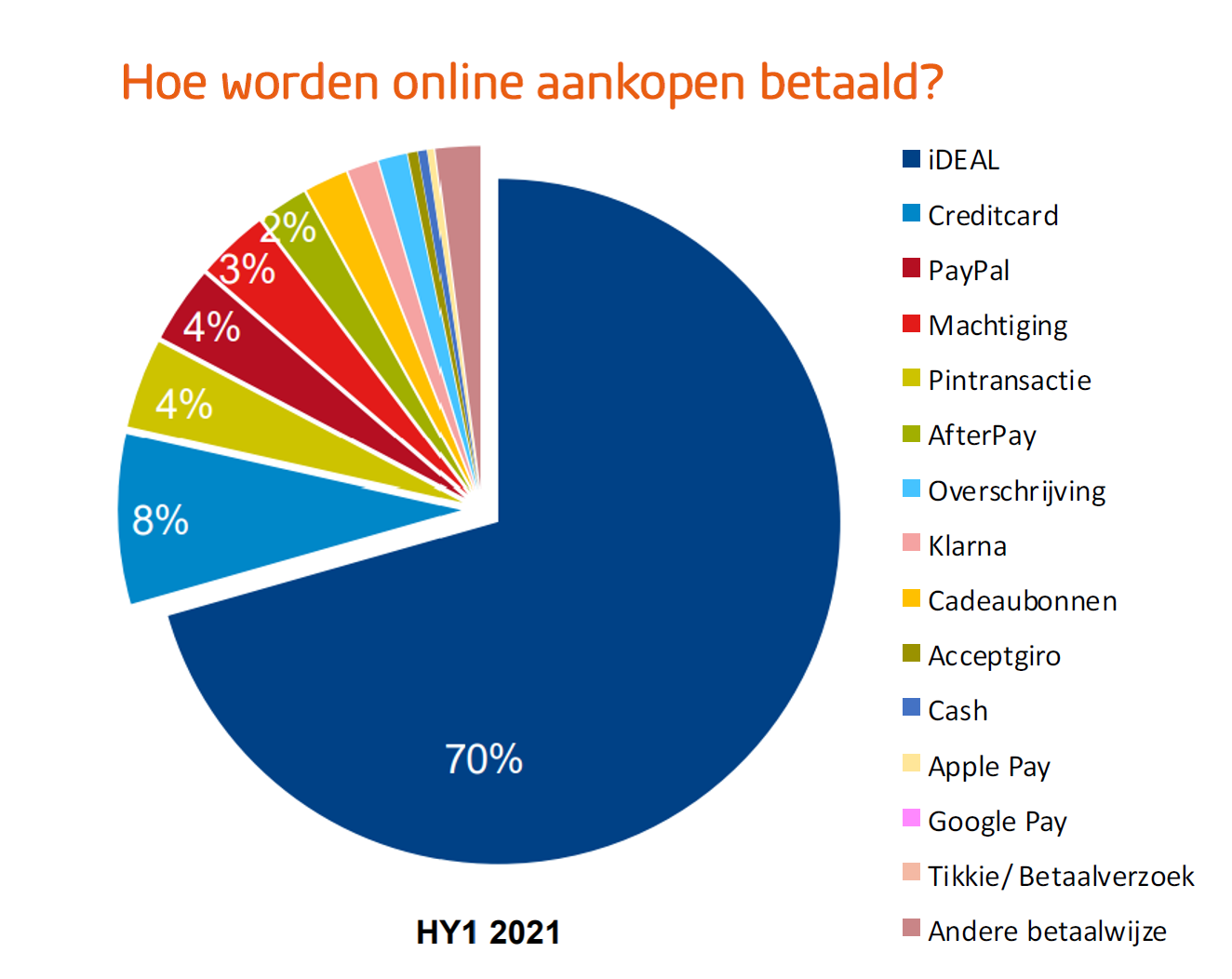
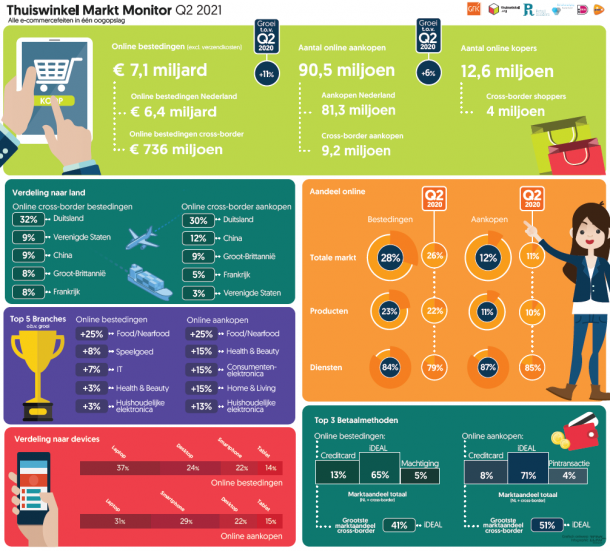
Total online consumer spending rose by 11% in the second quarter to €7.1 billion, while spending in the first half of the year increased by 19% overall to €14.8 billion. For the first time, most shoppers used a smartphone as a shopping device. Of all online buyers, 58% made at least one purchase on a smartphone, compared with 47% in the same period last year. The negative impact of Brexit on cross-border spending is also visible this year. These findings come from the latest Thuiswinkel Market Monitor, which studies online consumer spending in the Netherlands. GfK conducts the study on behalf of Thuiswinkel.org(opens in new window) and Retail Insiders(opens in new window) , in collaboration with PostNL(opens in new window) , the Dutch Payments Association and Currence(opens in new window) .
58% of online buyers make at least one purchase on a smartphone
In the first half of 2021, consumers made 182.2 million online purchases, an increase of 17% compared with the same period last year. Online purchases therefore accounted for 13% of all purchases. In Q2, more than a quarter of spending (28%) took place online. The lockdown at the start of the year, when non-essential retailers were closed or allowed to open only to a limited extent—first for click and collect and later by appointment—further accelerated the shift from offline to online.
“If you divide total online spending from the Thuiswinkel Market Monitor by the total retail turnover reported by Statistics Netherlands (CBS), €0.20 of every euro spent was spent online. The enormous growth of the online channel was partly driven by the COVID-19 measures. Shops fully reopened at the end of this research period, so we will be able to properly measure the lasting effect in the third quarter. Above all, the figures show what our e-commerce sector is capable of. Shops with an online channel have unprecedented growth potential,” says Marlene ten Ham, Managing Director of Thuiswinkel.org. Once again, a larger share of Dutch consumers bought online (95%). The first half of the year saw 1.2 million new e-shoppers.
Services sector growing again
Online spending on services grew strongly in the second quarter of 2021, rising by 30% compared with Q2 2020. Of all service segments, Package Holidays recorded the strongest increase (+99%). Spending on Tickets for Attractions & Events (+57%) and Individual Airline Tickets & Accommodation (+27%) also rose again in the second quarter of this year. However, online insurance purchases fell sharply (-12%). Marlene ten Ham explains: “The relaxation of COVID-19 travel restrictions led to an increase in the travel sector in the second quarter, but the extensive restrictions in Q1 mean that these online purchases were still lower in the first six months than in the same period last year.”
Nearly all product categories recorded growth in both online purchases (+22%) and online spending (+31%) in the first half of the year, with the exception of Sports & Recreation.
The online share also grew in every market segment, bringing the average online share for products to 27%. The strongest growth in online spending was recorded in Home & Living (+59%), Food/Nearfood (+49%), Toys (+48%) and Consumer Electronics (+46%). “The fact that we spent the first half of the year at home is clearly reflected in the Home & Living figures. However, Food/Nearfood growth was also largely driven by the market’s continued maturation, with a growing number of providers and the rise of concepts such as rapid grocery delivery services,” Marlene ten Ham explains.
Smartphone gains ground again for online purchases
Of all online buyers, 58% made at least one purchase on a smartphone. The smartphone’s share of both online purchases and online spending therefore increased compared with the first half of 2020. This came at the expense of desktop and laptop computers, although the laptop remained the most widely used device. “We have been saying it for some time: the smartphone is rapidly becoming the most important device for online shopping. It is therefore crucial for online retailers to make their webshops mobile-friendly; there is simply no avoiding it,” Marlene ten Ham says.
Growing popularity of Klarna and iDEAL
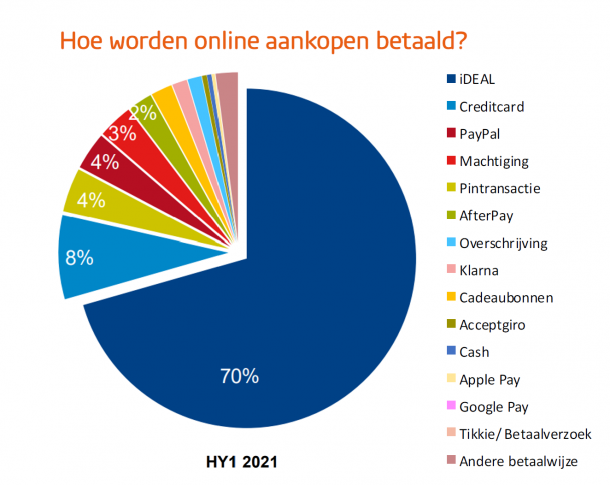
Klarna recorded the strongest growth in user numbers. In the first half of 2020, 10% of online shoppers used Klarna; in the same period this year, the figure was 18%. The number of buyers using iDEAL as a payment method also increased again: 96% of online buyers paid for at least one purchase with iDEAL (+7%). This kept iDEAL by far the largest payment method, with credit cards in second place at 25%.
Brexit visible in cross-border spending
In Q2, the number of online cross-border purchases of services grew strongly (+43%) compared with the second quarter of 2020. By contrast, cross-border product purchases fell by 12%. Spending on UK-based websites in particular declined as a result of Brexit, from 11% in Q1 2021 to 8% in Q2 2021. Spending on services purchased online increased due to the relaxation of travel restrictions. In the second quarter, almost a quarter of online spending on Individual Airline Tickets & Accommodation took place on foreign websites, an increase of 5% compared with Q2 2020. These purchases were made mainly on French or German websites.
Source: Statistics Netherlands (CBS). In the first six months of 2021, total retail turnover amounted to €75.6 billion. Retail includes online and offline spending on products, both food and non-food, including VAT. It also includes spending on household goods, recreational products, kitchens and food sold by petrol stations and pharmacies.
Related articles
-
Dutch abroad pay most with cards in Spanish hospitality
-
News
-
Card payments
-
-

High confidence in Dutch payment system
-
News
-
Card payments
-
-
Next Phase of iDEAL Migration to Wero Begins in October
-
News
-
Online payments
-
-

Lower travel spending is putting pressure on overall online spending
-
News
-
Online payments
-
-

The Digital Euro and Stablecoins: Apples and Oranges
-
News
-
European legislation
-
-
Banks are calling out social media platforms for their role in fraud and scams
-
News
-
Online payments
-