
Dutch e-commerce market benefits most from growth in online spending
Measures introduced in response to the COVID-19 outbreak once again gave online consumer spending a significant boost.
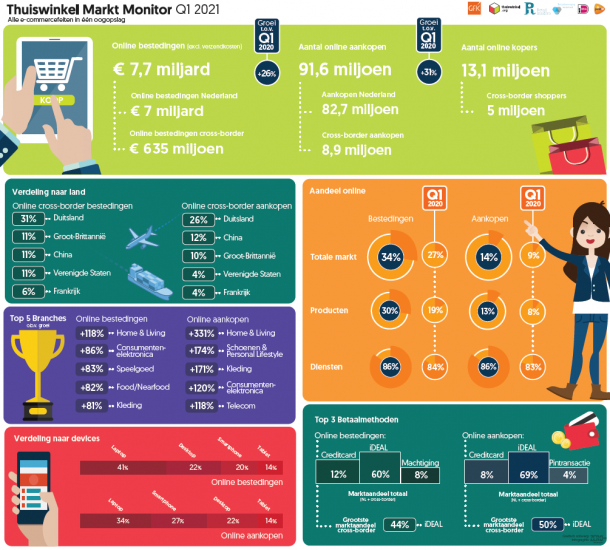
Not only were there almost one million more online buyers in Q1 this year than in the same period last year, but average spending per online buyer also rose sharply. Growth at Dutch webshops (+34%) was significantly stronger than at international webshops (+10%). These findings come from the latest Thuiswinkel Market Monitor, which studies online consumer spending in the Netherlands. GfK conducts the study on behalf of Thuiswinkel.org and Retail Insiders , in collaboration with PostNL , the Dutch Payments Association and Currence .
In Q1 2021, consumers made 91.6 million online purchases, an increase of 31% compared with the same period last year. Together, these purchases represented €7.7 billion in spending, up 26% from Q1 2020. This increase, also seen in Q4 2020, was partly caused by the partial lockdown at the start of the year, when non-essential shops were temporarily closed. “If we look at online spending on products, e-commerce now accounts for more than 22% of the total retail sector. That is the highest percentage ever recorded; it normally fluctuates around 10%,” says Marlene ten Ham, Managing Director of Thuiswinkel.org.
Across the border
The study also shows that more consumers made online purchases across the border than last year, although their total spending was lower. “Dutch consumers are spending slightly less across the border. Last year, they spent €681 million; this year, €635 million. The Dutch market is therefore benefiting most from the online growth, because many foreign purchases are linked to tourism,” Marlene ten Ham says.
Many new webshops this year
The shift to online sales that many physical shops began last year proved essential at the start of this year. “After the lockdown, we had to rely on click and collect for quite some time. Many physical shops launched a webshop alongside their existing business to generate some revenue. This revenue is included in the Thuiswinkel Market Monitor,” Marlene ten Ham explains. Statistics Netherlands figures show that more than 4,600 webshops were added in Q1 this year, compared with more than 2,200 in the same period last year.
As in recent quarters, categories related to the home recorded particularly strong growth. Online spending increased by 118% in Home & Living, 86% in Consumer Electronics and 83% in Toys. Food/Nearfood recorded the strongest growth in absolute terms this quarter. Increases in the number of online buyers, total spending and average spend almost doubled the category’s online share to 9%.
Cross-border purchases more often paid with iDEAL and Klarna
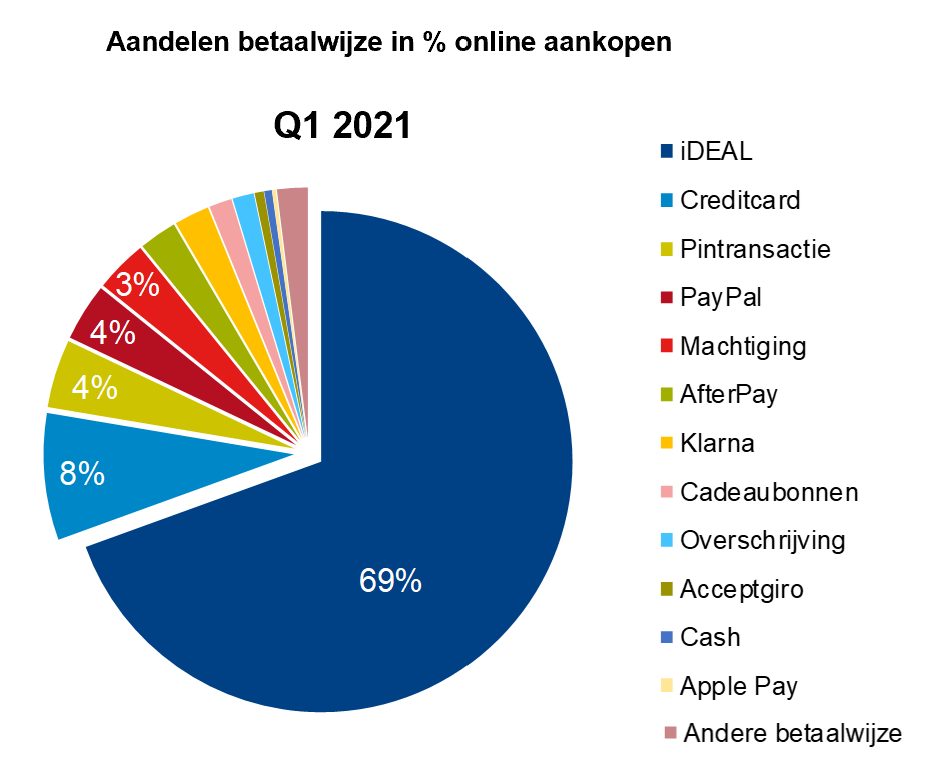
iDEAL’s share as a payment method for online purchases within the Netherlands remained high this quarter: iDEAL was used for 69% of online purchases and 60% of online spending. The shares of credit cards and direct debit as payment methods declined. iDEAL was also the most widely used payment method for cross-border purchases, accounting for 50% of the number of purchases. A typically Dutch payment method such as iDEAL is often used at foreign webshops because more and more international providers with large numbers of Dutch customers—including major webshops such as Amazon and AliExpress—offer iDEAL as a payment option. The shares of iDEAL and Klarna in cross-border purchases and spending increased, while the share of credit cards declined.
Related articles
-
Dutch abroad pay most with cards in Spanish hospitality
-
News
-
Card payments
-
-

High confidence in Dutch payment system
-
News
-
Card payments
-
-
Next Phase of iDEAL Migration to Wero Begins in October
-
News
-
Online payments
-
-

Lower travel spending is putting pressure on overall online spending
-
News
-
Online payments
-
-

The Digital Euro and Stablecoins: Apples and Oranges
-
News
-
European legislation
-
-
Banks are calling out social media platforms for their role in fraud and scams
-
News
-
Online payments
-