
Payments newsletter: Betaaljournaal 18
Last week, I presented our final report on the ‘Study into the costs and benefits of payments for financial institutions in 2021’ to our members and stakeholders. Thanks to the willingness of our major members to share their data, we now have, for the first time since 2006, a ‘clear picture’ of the costs and revenues. Based on this picture, we wish to engage in an open dialogue with all stakeholders to explore issues and joint next steps. These next steps must contribute to a future-proof funding model for the high standards of security, efficiency, reliability, accessibility and inclusivity of our payment systems.
Since Russia’s invasion of Ukraine, our efficient payment system has also been made accessible to over 50,000 Ukrainian refugees. At the start of October, access to these services became significantly easier for these refugees in the Netherlands, partly thanks to the joint efforts of our members. You can read more about this in this newsletter.
This newsletter also contains information on new promotional material about cash for retailers, ever-increasing online spending, the postponed large-scale migration of TARGET2, our presence at Sibos, the ‘Getting to Grips with Digital Banking’ pilot for vulnerable bank customers and, finally, fallback options in the event of debit card malfunctions.
Gijs Boudewijn, Acting Managing Director

- Cost-benefit analysis of payments in 2021
- Instant Payments soon to become the new normal outside the Netherlands too
- More opportunities for Ukrainians in the Netherlands to apply for a current account
- Digital fallback options for the debit card infrastructure project launched
- Survey of measures for debit card outages
- New ‘Cash also welcome’ stickers available free of charge
- Online spending grows by 9% to €16.1 billion in the first half of 2022
- ECB postpones TARGET2 migration until 20 March 2023
- Sibos
- Partner banks launch ‘Getting to grips with (digital) banking’ pilot
- Open banking and the SPAA consultation
- Figures
- Calendar
- Association news
Study into the costs and benefits of payments in 2021
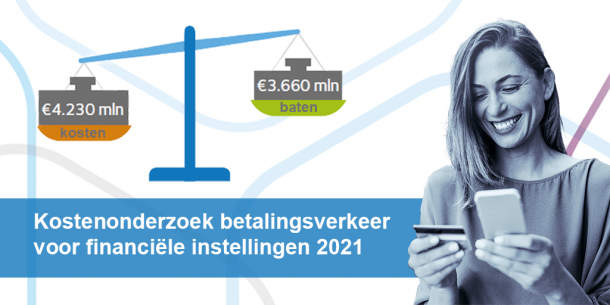
As is well known, the Dutch Payments Association commissioned a study into the costs and benefits of payments in 2021. The last large-scale study on this subject dates back to 2005. Much has changed in the payments market since 2005: new payment products have emerged, whilst others have disappeared, and new types of players are now active in the market. Above all, the payments sector now operates on a European scale and the digitalisation of payments has increased significantly.
The 2021 study makes it clear that, since 2005, we have collectively achieved enormous efficiency gains: in 2021, 2.5 times as many payments were processed as in 2005 at roughly the same cost. At the same time, we note that providers (our members) have to invest heavily in payments – 570 million euros in 2021.
We are very grateful to the stakeholders for the constructive way in which they contributed to the development of a robust methodology for mapping costs and revenues, and for their feedback during the study. We are also very grateful to De Nederlandsche Bank for their support and close involvement in the study. The research report can be found here.
Instant Payments soon to become the new normal outside the Netherlands too

The European Commission has announced that Instant Payments will soon become mandatory for all providers of European bank transfers, at no additional cost to users. To prevent errors and certain forms of fraud, banks must offer payers the option to verify that the name matches the beneficiary’s IBAN for every digital transfer.
In the Netherlands, Instant Payments have been the new normal for a few years now. At virtually all Dutch retail banks, transfers via mobile and online banking are processed as Instant Payments, at no extra cost to the customer. Dutch banks are already fully equipped to handle Instant Payments to and from all other banks in Europe that support this service.
Dutch banks have also been voluntarily offering a check against the name associated with a beneficiary’s IBAN for many years, known as the ‘IBAN Name Check’. This service issues a warning if the payer enters an incorrect beneficiary name for an IBAN, without revealing the correct name. If they wish, the payer can ignore this warning and proceed with the transfer anyway.
More options for Ukrainians in the Netherlands to apply for a current account
From Monday 3 October, Ukrainian refugees in the Netherlands have been given more options to apply for a current account. This can now be done using documents that previously could not be accepted by payment service providers. Currently, over 91 per cent of all adult Ukrainian refugees have a current account in the Netherlands. This was mainly achieved using various internationally recognised and valid English-language identity documents. For the remaining small group of refugees in the Netherlands who were unable to open a current account, there are now additional options for applying for one. These new options have been made possible thanks to close cooperation between the Ukrainian Embassy, banks and other providers of current accounts, the Dutch Payments Association, the Dutch Banking Association (NVB), regulators and government bodies. Would you like to know exactly what these options are? Then read our press release of 30 September here.
Digital fallback options for the debit card infrastructure project launched
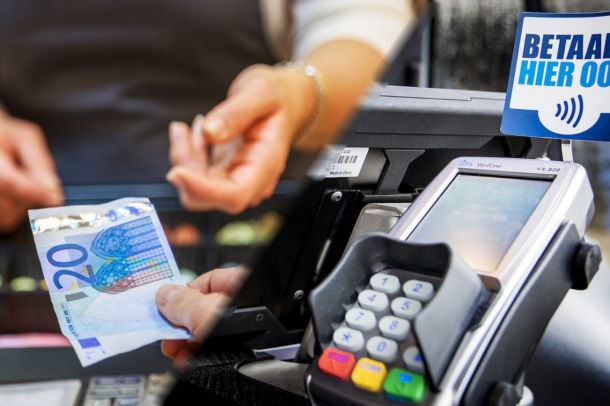
The Dutch debit card infrastructure is extremely reliable and has an availability rate of virtually 100 per cent. Due to the declining use of cash, more and more people are carrying little or no cash with them. Consequently, should a debit card disruption unexpectedly occur, cash is increasingly no longer a fallback option. That is why agreements have been made in the Cash Covenant regarding digital fallback options for debit card payments in the event that the debit card infrastructure fails or experiences a disruption. On 29 September, the kick-off meeting for the ‘Digital Fallback Options for Debit Card Infrastructure’ project took place at the Dutch Payments Association. The entire debit card sector was represented: banks, card schemes, payment terminal suppliers and retailers. The aim of the project is to ensure that every retailer in the Netherlands, if they so wish, will have access to an alternative fallback solution by the end of 2023 at the latest, in the event of a debit card infrastructure failure.
Survey of measures for debit card outages
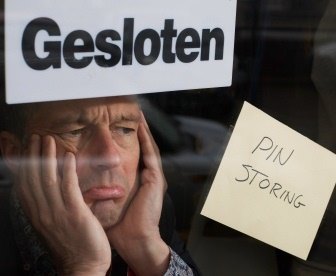
To gain a better understanding of the extent to which high-street retailers are affected by debit card disruptions, a telephone survey was conducted over the summer among more than 450 branches of high-street retailers. The survey asked what measures they had taken themselves to prevent debit card disruptions and what they do if a customer does not have cash on them when a debit card disruption occurs. The survey shows that the number of debit card payment failures experienced by businesses on an annual basis is limited. 38% of respondents stated that they never experience a debit card payment failure. The main causes cited for such failures were disruptions to the internet or telecoms connection and malfunctions of the payment terminal.
Although cash is still seen by many business owners as an important fallback option, we are seeing that smaller business owners in particular are already making use of alternatives such as bank transfers or payment requests. In practice, these solutions are less suitable for large-scale retailers, such as supermarkets. There are currently few alternatives available for this group. The ‘Digital Fallback Options for Card Payment Infrastructure’ project aims to ensure that this group of business owners also has access to adequate fallback options alongside cash. Read the research here.
New ‘Cash also welcome’ stickers available free of charge
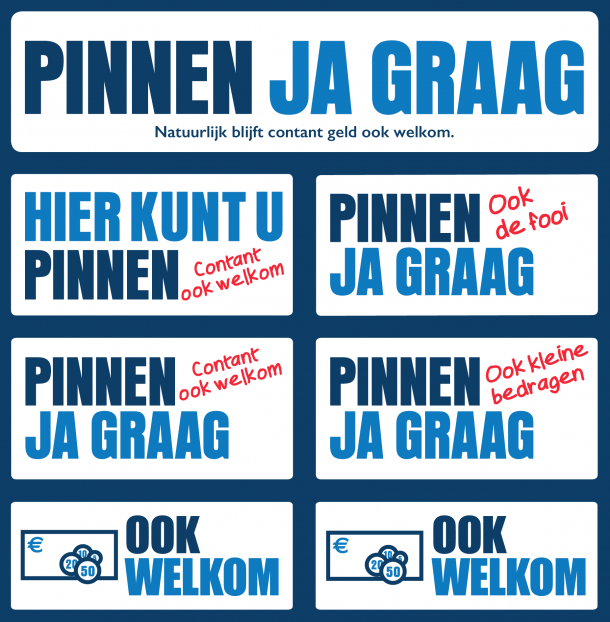
To make it clear to customers that they can also pay by cash, new stickers are now available via the PIN.nl webshop . There are various designs, so business owners can choose the sticker that best suits their business. All designs are included on a single sticker sheet. The sticker sheets can be ordered free of charge via Promotional Material – PIN.NL . They are also included free of charge with orders for other stickers via the PIN.NL webshop. Finally, they have also been made available to trade associations and payment terminal suppliers for distribution to their members and customers.
Online spending grows by 9% to €16.1 billion in the first half of 2022
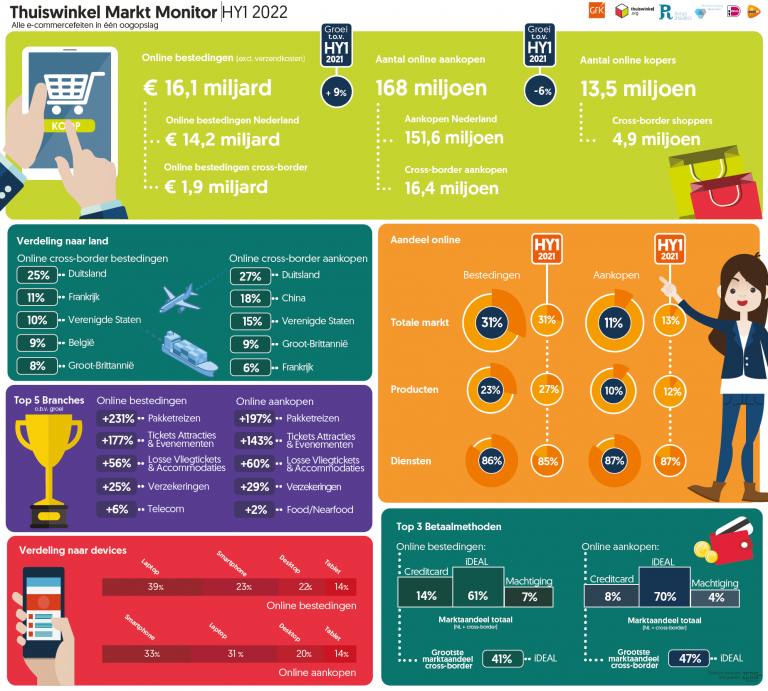
In the first half of 2022, online spending by Dutch consumers totalled €16.1 billion. This represents a 9% increase compared with the same period last year. The growth is being driven by the sharp rise in services, namely 86%. “The strong growth in services is mainly due to the rise in sales of tickets for events and theme parks, as well as package holidays and airline tickets. Online ticket purchases nearly doubled in Q2 compared with the same period last year. This clearly correlates with six months without Covid-19 restrictions,” says Marlene ten Ham, director at Thuiswinkel.org. Online spending on products also remains above pre-COVID levels, although we are seeing a decline of 11 per cent compared with the same period last year. This is evident from the latest figures from the Thuiswinkel Market Monitor. Would you like to read more about the latest figures from the Thuiswinkel Market Monitor? Click here.
ECB postpones TARGET2 migration until 20 March 2023

On 20 October, the ECB’s Governing Council decided to postpone the go-live of the new TARGET2 platform until 20 March 2023. The launch was originally scheduled for 21 November 2022. The decision to postpone was primarily driven by the need for banks to be able to test the system for longer and more effectively in a stable environment. The additional four months will contribute to the stability of the system and ensure that users can prepare more effectively. This will make the transition to the new T2 platform smoother. Dutch banks share the concerns underlying this decision.
For banks, the T2 implementation involves, amongst other things, a new account system at the central bank, adapted connections and the introduction of the ISO 20022 messaging standard. The postponement has far-reaching consequences. SWIFT, for example, has also decided to postpone the introduction of ISO 20022 . With this postponement, the Dutch interbank consultation structure regarding the T2 implementation remains intact for the time being. The Dutch Payments Association will continue to assist in coordinating the end-to-end tests.
Sibos

On 10 October 2022, Queen Máxima opened the Sibos conference (formerly known as the SWIFT International Banking Operations Seminar) at the Amsterdam RAI, where several thousand financial professionals from around the world gathered. Among other things, the conference brought together a large number of people from the world of European payments. However, the payments professionals from the Dutch Payments Association’s network and the four largest Dutch banks had already met the day before the conference began at Strand Zuid, right next to the conference venue. During this reception, there was an opportunity to catch up with old contacts and discuss new developments in the sector. Gottfried Leibbrandt, Chairman of the Dutch Payments Association, addressed those present with a welcome speech. Afterwards, there was an opportunity to catch up with one another in the autumn sunshine. Conference attendees were also able to collect their badges in advance for the following day. The gathering was well attended and had an energetic atmosphere, marking the start of a busy week of information exchange and networking for those present.
Partnering banks launch ‘Getting to grips with (digital) banking’ pilot

“Alone you go fast, but together you go further.” A motto that drives banks to take joint steps towards greater accessibility and inclusivity. ABN AMRO, ING and Rabobank have recently joined forces. A pilot scheme was launched in October in three cities, where anyone with questions about banking can seek help. This is available during special walk-in consultation hours at the Central Library in Rotterdam, the Overvecht Library in Utrecht and the Deventer Library. The pilot is aimed in particular at over three million Dutch people in vulnerable situations. These include older people, those with low literacy levels and people with physical or intellectual disabilities. The volunteers – retired staff from major banks – act as the linchpin of the scheme and have been present for two hours a week ever since. They refer people to the appropriate channels and help them to formulate their requests for assistance clearly. Where possible, the volunteers provide information themselves, but for complex or specialised queries they always refer people to certified financial experts. They also provide impartial information, regardless of which bank a person is a customer of.
Open banking and the SPAA consultation

With the introduction of the revised Payment Services Directive (PSD2), licensed third parties gained free access to a consumer’s current account following explicit consent. This is known as open banking. Third parties can thus provide account information and/or payment initiation services to consumers. For example, they can display balances across current accounts at different banks in a single overview, or automatically categorise transactions and offer money-saving tips. Earlier this year, the Dutch Payments Association launched the Open Banking Working Group to, amongst other things, facilitate collaboration within the Dutch industry and monitor (European) initiatives.
One such European initiative is the development of the SEPA Payment Account Access (SPAA) scheme. PSD2 has not yet led to any major developments in the market, which is why the industry is looking ahead collectively. Under the auspices of the European Payments Council (EPC), banks and payment institutions are working together to develop new premium services and to set these out in a framework (scheme). This will enable third parties to offer more services to customers, whilst banks can receive a fee for providing access, in order to maintain the gateway that provides access to the payment account. In the Netherlands, the Dutch Payments Association is closely involved in this initiative, together with the Open Banking Working Group, and in Brussels via the EPC’s SPAA Multi-Stakeholder Group. In September, the working group responded to the EPC SPAA rulebook consultation; the response can be found here.
Figures
446 million debit card payments at the till in September. Of these, 87.22% were contactless.
Agenda
- 27 October – Advisory Board
- 15 November – Autumn meeting of the National Forum on the Payment System at De Nederlandsche Bank (Spaklerweg, Amsterdam)
- 17 November – Board meeting and General Meeting of Members
- 24 November – Advisory Council for Payment Institutions
- 8 December – Advisory Board
- 19 December – Board meeting
Association News
On Thursday 17 November from 15:00 to 17:00, the Dutch Payments Association will be holding its half-yearly General Meeting of Members in the Auditorium at Symphony Offices, followed by an informative and interactive programme on Open Banking. This General Meeting of Members is a private event and open to members only. You can register here.
Members’ Bulletin
In addition to this Betaaljournaal, the Dutch Payments Association also publishes Members’ Bulletins. The bulletins are usually published a few times a month and focus on a specific theme. You may be a member but not yet receiving these bulletins. You can ask to be added to the mailing list by emailing secretariaat@betaalvereniging.nl.
Subscribe to the Betaaljournaal
Are you also curious about the latest developments in the payments sector? Stay up to date via the Betaaljournaal. You can subscribe here.
Related articles
-
Growing number of people are satisfied with handling their daily banking affairs
-
News
-
Payments for all
-
-
A2A payments continue to grow
-
News
-
Online payments
-
-
New bank account numbers Dutch Tax Administration
-
News
-
Account-to-Account payments
-
-

BIC List Now Accessible
-
News
-
IBAN and BIC
-
-

Grand Opening of Renovated Office Celebrated
-
News
-
-
Make sure you have (digital) fallback options in case of a potential card payments failure!
-
News
-
Card payments
-