Payment accounts: what to look out for when choosing?
Choosing a current account is an important decision, both for consumers and business owners. What is on offer and how can you choose? Below, we list the main points of interest and options to consider.

1. Different types of current account providers
In the Netherlands, you can turn to different types of current account providers. Not only banks can offer payment accounts, but also non-bank so-called EGIs (electronic money institutions). We list the different types of providers:
- Traditional banks: These often offer a wide range of services, such as current and savings accounts, loans and insurance. Some traditional banks still have physical branches or service points that customers can visit and they still support paper transfer forms and paper bank statements.
- Neo-banks: These are relatively new, mostly fully digital banks that focus on digital convenience and low costs for basic services.
- Electronic money institutions (EGIs): EGIs are not banks but they are supervised. At an ELMI, you cannot save or borrow. You do get a common debit card and can make and receive all common payments. EGIs focus mainly on specific payment solutions and usually offer simple, digital payment accounts. They are not covered by a deposit guarantee scheme.
Note: In the following, we refer to all current account providers as “banks” for convenience, unless the distinction between banks and ELMIs really matters.
2. Dutch or foreign IBAN
In the Netherlands, you can choose between current accounts with Dutch IBANs or with IBANs from other SEPA countries (IBAN stands for International Bank Account Number). In principle, all IBANs from all SEPA countries are equivalent but there are differences:
- Single Euro Payments Area (SEPA): SEPA includes all EU countries, supplemented by some non-EU countries that neatly adhere to all EU rules and agreements for euro payments. SEPA countries outside the EU include, for example, the UK, Norway and Switzerland. Between all SEPA countries, euro payments are largely harmonised . This means that someone between two different SEPA countries can send or receive a transfer in euros with the same ease as within the Netherlands.
- Direct debits: Businesses and institutions should not discriminate against IBANs of customers from other SEPA countries but, unfortunately, in practice this still seems to happen. Especially for direct debits, some billers in a particular SEPA country (in the Netherlands) still cannot handle IBANs of customers from other SEPA countries.
- Domestic collective banking services: The Netherlands has a number of domestic collective facilities between banks in which banks from other SEPA countries do not (yet) participate. For example, you can only use the Dutch Overstapservice to switch between two banks with Dutch IBANs (and EGIs do not participate in the Overstapservice).
3. Paying with iDEAL
iDEAL is the most widely used online payment method in the Netherlands . With most Dutch banks, paying with iDEAL is included as standard with every payment account. With some banks from other euro countries, with a foreign IBAN, iDEAL is also included, for account holders residing in the Netherlands.
All commonly used Dutch mobile payment requests (such as Tikkie’s) use iDEAL. Therefore, bank customers who cannot pay with iDEAL cannot pay friends and family via Dutch mobile payment requests.
4. Instant Payments
Between Dutch banks, account holders can almost always make quick digital transfers with a so-called Instant Payment, without any extra costs. The amount is then in the recipient’s checking account within seconds.
From October 2025, all SEPA banks must be able to send and receive Instant Payments for all digital transfers in euro. EGIs will get a slightly longer grace period – until April 2027 – but if they want, they can already support Instant Payments now.
Until banks and ELMIs have to support Instant Payments on a mandatory basis, a transfer to or from a bank or ELMI from another SEPA country may still take one or two working days on the road.
5. Deposit Guarantee Scheme
- Private individuals at a bank: The deposit guarantee scheme protects the total balance (‘deposit’) of a private customer at a Dutch bank up to €100,000, in case that bank goes bankrupt. Many other SEPA countries also have a deposit guarantee scheme, usually also for a guarantee amount of around €100,000 per private account holder. If you choose a bank from another SEPA country, that bank will fall under that country’s deposit guarantee scheme. Therefore, find out first whether and for what amount a bank from another SEPA country falls under a deposit guarantee scheme before opening a checking account there.
- Entrepreneurs at a bank: Deposits of business bank customers in the Netherlands only fall under the Deposit Guarantee Scheme if the account holder is a relatively small entrepreneur. Think of sole traders and ZZP’ers. This may be different in other SEPA countries. Read more about the Dutch deposit guarantee scheme
- Electronic money institutions (ELIs): All account holder balances at EGIs are not covered by a deposit guarantee scheme. EGIs do offer other safeguards, such as strictly separating customer deposits from the EGI’s own capital. Check carefully what securities an ELMI offers if you want to deposit a large amount in a checking account there.
6. Special types of accounts
Many banks offer special checking accounts for individuals, such as and/or accounts with two or more equal account holders, or accounts with certain restrictions for minors. Not all banks offer these types of accounts so pay attention to that when choosing a bank.
For business owners, the variety of checking account offerings is even greater. Therefore, find out carefully whether a particular bank’s services and rates are a good match for your needs and requirements as a business owner.
Reviewing and approving a new business customer can take weeks to months. A bank may also reject a business checking account application completely.
7. Cash withdrawals and deposits
With a debit card from any bank, you can withdraw cash from almost all ATMs worldwide. However, with some banks or with some account types, this is not included in the monthly fixed account fee, even for withdrawing cash in the Netherlands.
If you regularly want to withdraw cash in the Netherlands, find a bank or account type that does not charge extra for it.
Only some traditional banks allow you to deposit cash and you will usually have to pay separately for that. Depositing money is rarely included for free in the fixed monthly fee.
8. Costs and fees
Current account fees and rates can vary widely, depending on the services available and what you use:
Fixed monthly fees: This usually includes many services in full, such as all transfers and direct debits within SEPA, a common debit card and all payments made with it in euro countries, iDEAL payments and sending or paying mobile payment requests. However, each bank can deviate from these so look carefully at the rates and conditions of the bank that catches your eye.
Variable (transaction) fees: These apply to all transactions and services not included in the fixed monthly fee. These include fees for cash withdrawals and deposits, fees for transfers to countries outside SEPA (outside Europe), fees for payments using a debit card outside Europe, or fees for requesting an additional debit card.
9. Overview of current account providers in the Netherlands
Below we show an overview of banks and ECI’s offering payment accounts in the Netherlands. For each bank, we indicate some general characteristics:
- Bank or EGI
- Dutch IBAN or not
- Payment with or without iDEAL
- Country of deposit guarantee scheme (dgs)
When making your choice, don’t forget to also consider the customer service and accessibility of the various banking and payment services. A small number of banks still have branches or service points that you can visit for a personal consultation. Most banks are only accessible by phone and digitally. Some neo-banks and EGIs can only be reached digitally, through their website or mobile app.
Table updated on 13 November 2025.
| NAAM | bank of EGI | Ned. IBAN | iDEAL | land dgs |
|---|---|---|---|---|
| ABN AMRO | bank | ja | ja | NLD |
| ASN Bank | bank | ja | ja | NLD |
| Barclays Bank | bank | nee | nee | IRL |
| Bunq | bank | ja | ja | NLD |
| BUUT | bank | ja | ja | NLD |
| Genome | EGI | nee | nee | – |
| ING | bank | ja | ja | NLD |
| INSIFR | EGI | ja | nee | – |
| Knab | bank | ja | ja | NLD |
| NN Bank | bank | ja | ja | NLD |
| N26 | bank | nee | ja | DEU |
| Openbank | bank | nee | nee | ESP |
| Rabobank | bank | ja | ja | NLD |
| Revolut | bank | ja | ja | NLD |
| Trade Republic | bank | nee | nee | DEU |
| Triodos Bank | bank | ja | ja | NLD |
| Van Lanschot Kempen | bank | ja | ja | NLD |
| Vivid | EGI | ja | nee | – |
| Wise | EGI | nee | nee | BEL |
| Wittix | EGI | nee | nee | – |
| Yoursafe | EGI | ja | ja | – |
| ALLEEN ZAKELIJK | bank of EGI | Ned. IBAN | iDEAL | land dgs |
|---|---|---|---|---|
| FINCI | EGI | nee | nee | – |
| Finom | EGI | ja | nee | – |
| GoDutch | EGI | ja | nee | FRA |
| Moneybird | bank | ja | nee | NLD |
| myPOS | EGI | nee | nee | – |
| Qonto | EGI | nee | nee | – |
| Snelstart | bank | ja | nee | NLD |
| Tellow | EGI | ja | nee | – |
Gerelateerde artikelen
-
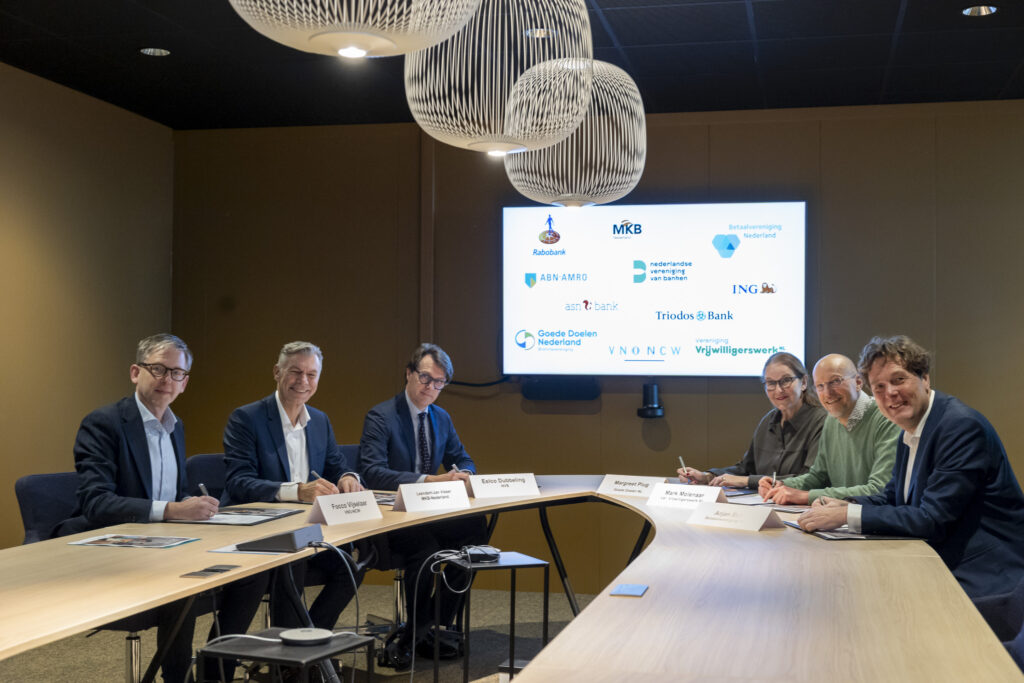
New agreements should improve access to business checking account
-
News
-
Special accounts and services
-
-

Consumers are buying more products and fewer services online
-
Press releases
-
Online payments
-
-

Super-fast and secure transfers between all euro countries from now on
-
News
-
Market infrastructure
-
-

Stablecoins: ‘protecting and participating’
-
News
-
Crypto
-
-

Consumers increasingly buy online via smartphone
-
News
-
Online payments
-
-

Payments newsletter: Betaaljournaal 34
-
Payments newsletter
-