
Contactless payments becoming commonplace
Contactless payments continue to grow rapidly across all demographic groups, at an increasing number of shops and for increasingly large amounts. This is shown by measurements by the Dutch Payments Association and De Nederlandsche Bank (infographic in Dutch).
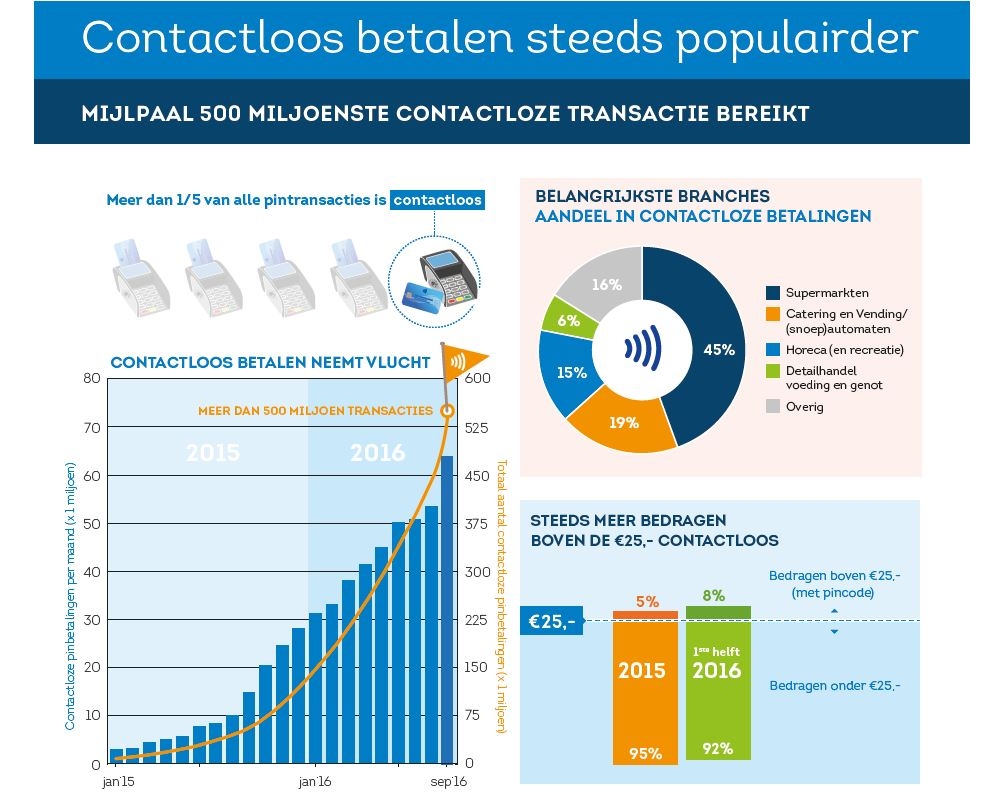
Contactless payments grew by an average of 10% per month in 2016. More than half a billion contactless payments have now been made in the Netherlands. September saw 65 million contactless payments, representing more than one in every five debit card payments that month.
For larger amounts
While contactless payments were initially used mainly for small amounts up to and including €25 without a PIN, they are now increasingly used for amounts above €25 with a PIN. In 2015, amounts over €25 accounted for 5% of all contactless payments. In the first half of 2016, this share had already increased by more than half to 8%.
In catering and at vending machines
Contactless payments can now be made at more than half of all points of sale in the Netherlands, and that number is growing each month. Several major supermarket and department-store chains recently replaced their payment terminals with contactless models.
Supermarkets account for the largest share of contactless payments at 45% of the total. Catering, including workplace canteens, and vending machines for products such as sweets, snacks and soft drinks account for almost one-fifth of all contactless transactions. Car parks are seeing rapid growth in contactless payments as more contactless terminals are installed.
More women and older people
Differences in the popularity of contactless payments between men and women and between age groups are narrowing. Last year, women made only 38% of all contactless payments; in the first half of 2016, women already accounted for 43% of contactless users.
Older people are also becoming convinced of the convenience and security of contactless payments. Small amounts up to and including €25 usually require no PIN, so pickpockets cannot observe it being entered. Users also no longer need to hand over a contactless debit card, making it less likely that they will forget or lose it. If a debit card nevertheless falls into someone else’s hands and is used to make contactless payments without a PIN, the customer’s bank reimburses the losses.
Related articles
-
Dutch abroad pay most with cards in Spanish hospitality
-
News
-
Card payments
-
-

High confidence in Dutch payment system
-
News
-
Card payments
-
-
Checking In and Out on Public Transportation Is Now Even Smoother with Your Smartphone
-
News
-
Card payments
-
-
More travelers very satisfied about traveling with payment card
-
Press release
-
Card payments
-
-

Six out of ten retail business owners say they are prepared for card payments failures
-
News
-
Card payments
-
-
Make sure you have (digital) fallback options in case of a potential card payments failure!
-
News
-
Card payments
-