
Banks investigate incorrect transfers
On 25 January, the Dutch Payments Association discussed with the Dutch Consumers’ Association the findings of research into undue payments.
In 2015, the Dutch Payments Association and the Dutch Consumers’ Association agreed to investigate how often consumers used the Undue Payment Procedure (POB) in 2016 and why. The POB is intended to help consumers recover money that they accidentally transferred to the wrong beneficiary, resulting in an undue payment.
The research found that private bank customers used the POB 14,357 times from February to December 2016, an average of 1,305 times per month. This is a decrease compared with 2014 and 2015, when the POB was used an average of 4,500 and 1,500 times per month respectively.
Incorrect use of address books
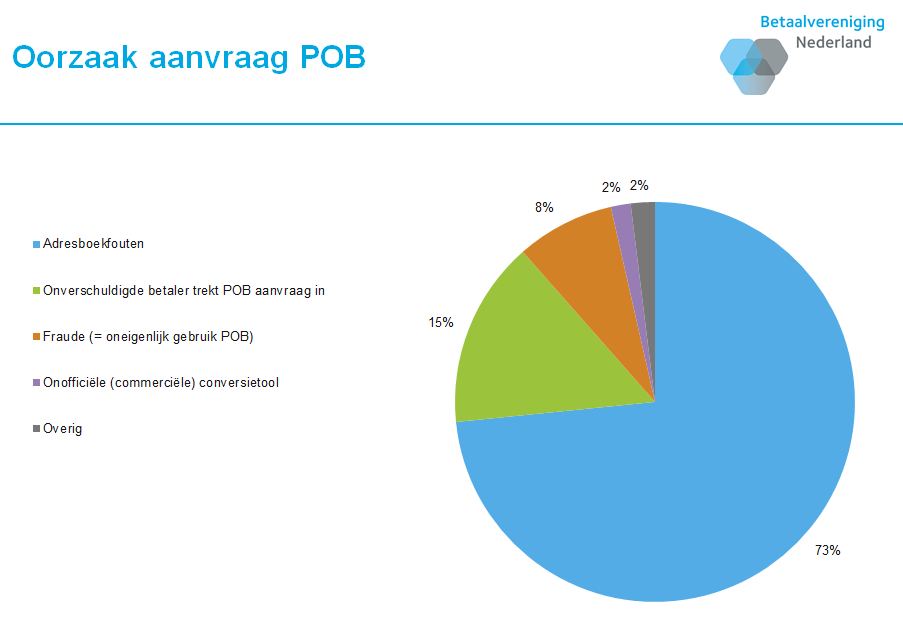
The causes of accidental transfers were also investigated. Incorrect use of outdated information in account holders’ address books is by far the main cause, accounting for 73%. In 15% of cases, bank customers withdrew a POB request, for example because the unintended recipient had already returned the money. In 8% of cases, the POB was used because fraud was involved. The use of unofficial IBAN conversion tools, which generate someone else’s IBAN, caused an undue payment in 2% of cases, while another 2% fell into the ‘other’ category.
No reissue of IBANs
Address-book errors are therefore the main cause of undue payments. They may occur because an expired and reissued IBAN remains in an address book, the wrong beneficiary is selected, or a name or account number is stored incorrectly. The Dutch Consumers’ Association called for the following measures to address address-book errors:
- Banks that have not already decided to stop reissuing expired IBANs are strongly urged to do so. The Dutch Payments Association has been asked to bring this to banks’ attention.
- To remove reissued IBANs that remain in address books, the Dutch Payments Association has been asked to discuss with banks how those address books can be cleaned up. The Dutch Consumers’ Association suggests a combination of individual actions, such as a pop-up when a long-unused IBAN is selected, and collective awareness measures, such as a national clean-up day. Some banks are already introducing such measures.
- Banks are asked to review the usability of their address books, for example to help older people avoid mistakes by using greater contrast and similar measures.
Tackling fraud remains an important priority for the Dutch Consumers’ Association. It therefore called for further research into the ‘fraud’ category, which represents 8% of the total. It also requested that the number of fraud reports referred to the judicial authorities be recorded. The research shows that the POB was not initiated for 10% of applications. The Dutch Payments Association currently has insufficient detailed information to distinguish further within this category and has agreed to investigate.
Finally, the Dutch Consumers’ Association advised the Dutch Payments Association to continue monitoring how often the POB is used in 2017 so that the effect of new measures can be determined.
The AVROTROS television programme Opgelicht?! (in Dutch)(opens in new window) also devotes considerable attention to fraud on online marketplaces, including cases where a reliable seller’s identity is hijacked and unsuspecting buyers transfer money to a scammer’s bank account.
Related articles
-

High confidence in Dutch payment system
-
News
-
Card payments
-
-

BIC and identifier ‘SNNNNL2A’ added to the SEPA BIC list
-
IBAN/BIC list
-
IBAN and BIC
-
-
BIC and identifier ‘BUXANL22’ added to the SEPA BIC list
-
IBAN/BIC list
-
IBAN and BIC
-
-
BIC and Identifier “XTAFNL2A” Added to the SEPA BIC List
-
IBAN/BIC list
-
IBAN and BIC
-
-
New bank account numbers Dutch Tax Administration
-
News
-
Account-to-Account payments
-
-

BIC List Now Accessible
-
News
-
IBAN and BIC
-