
Sharp rise in phishing and debit card fraud in 2019
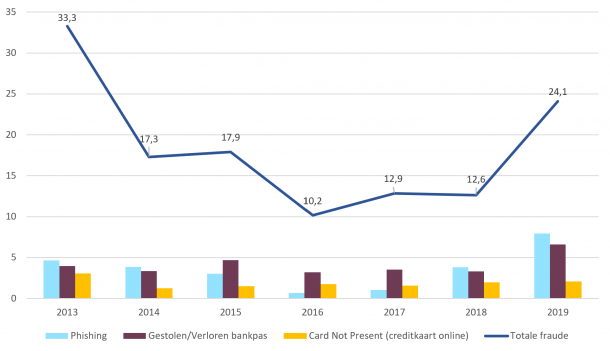
Losses caused by phishing for internet banking security codes more than doubled last year, from €3.81 million in 2018 to €7.94 million in 2019.
During 2019, banks observed a sharp increase in attempts to commit fraud and scam customers. Fraudsters also used a wider range of channels to approach their victims. In addition to email, they used text messages, WhatsApp, Messenger, Marktplaats and Twitter to send fraudulent messages.
The much larger number of attacks, the range of channels and continually changing pretexts also caused losses to rise sharply. Total losses from fraud in payments amounted to €24.1 million last year, compared with €12.6 million a year earlier.
Phishing for debit cards and PINs
Losses caused by stolen or lost debit cards almost doubled in one year, from €3.32 million to €6.61 million. Fraud involving stolen debit cards often begins with a phishing email or fraudulent text message. This deceives recipients into sending their debit card by post and disclosing the associated PIN, for example on a fraudulent website.
Fraudsters are quick to exploit current events. During the COVID-19 crisis, for example, they sent fraudulent messages or called people to say that they had to return their current debit card in exchange for a supposedly ‘antibacterial’ card. Banks never ask customers to send in their debit card.
Online misuse of stolen credit card details
Online misuse of stolen card details has traditionally caused the largest share of credit card fraud losses. In 2019, these losses amounted to €2.08 million, 5% more than in the previous year. They were expected to fall sharply in 2021 following the mandatory introduction of two-step verification for online credit card payments throughout the EU in 2020.
Prevention by banks and their customers
Banks continually invest in stricter monitoring of online transactions and innovations for secure point-of-sale payments. Secure smartphone apps using fingerprint or facial recognition, for example, help reduce fraud in online banking and payments.
Electronic point-of-sale payments are becoming safer thanks to contactless payments made with a debit card, smartphone or smart wearable. Contactless payment gives criminals far less opportunity to watch someone enter their PIN. Cardholders can also more easily prevent fraudsters from secretly swapping their debit card, as they do not need to hand it over when paying contactlessly.
Bank customers’ own efforts and vigilance also remain important in reducing fraud. The best protection against fraud and scams is for customers to recognise fraudulent messages and other attempted scams in time. Banks keep the issue in the public eye through an ongoing awareness campaign about common types of fraud.
VeiligBankieren.nl (in Dutch) provides useful advice and tips.
Related articles
-

Pay-by-Bank, what is it?
-
News
-
Online payments
-
-
A2A payments continue to grow
-
News
-
Online payments
-
-
Dutch abroad pay most with cards in Spanish hospitality
-
News
-
Card payments
-
-

The Payments Association at GDC26: digital identity and payments
-
News
-
Digital identity
-
-

High confidence in Dutch payment system
-
News
-
Card payments
-
-

Industry organisations: involve the financial sector in the roll-out of digital wallets
-
News
-
Digital identity
-