
Sharp rise in cybercrime causes higher losses
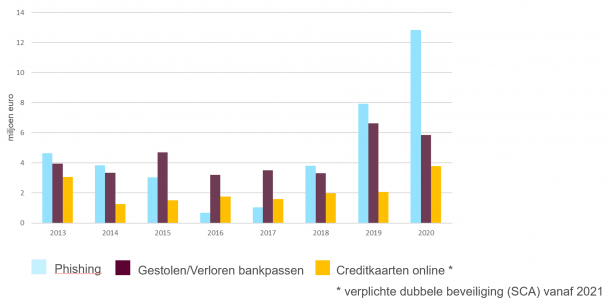
Total losses from phishing and telephone spoofing in payments amounted to €39.5 million in 2020. This consisted of €12.8 million in phishing losses and €26.7 million in number spoofing losses. In 2019, phishing alone caused losses of €7.9 million; telephone spoofing, also known as bank helpdesk impersonation fraud, was still rare at the time.
This alarming increase in total losses from fraud and scams underlines the need to rapidly develop an integrated approach to these forms of cybercrime with the government and other parties.
To tackle the societal problem of fraud and scams more effectively, banks believe that prevention must be accompanied by investigation and prosecution of perpetrators. Banks therefore want it to become easier for the police, banks and telecom sector to exchange information about perpetrators. They welcome the previously announced integrated approach in which law enforcement agencies, ministries, the telecom sector, internet companies, payment institutions and banks join forces against cybercrime. The 2020 figures once again show how urgent such an approach is.
COVID-19, social media and data breaches lower the barriers
Several factors have contributed to the much higher losses from fraud and scams in payments. Because of COVID-19, we have more online contact with friends, webshops, companies and public bodies. This makes it easier for fraudsters to exploit the situation and reach potential victims online.
Fraudsters’ fake messages and websites have become much better, smarter and more convincing, without spelling or formatting errors. Using a wealth of personal data obtained from data breaches, Facebook, Marktplaats, Instagram, LinkedIn and other social media, fraudsters deceive victims very convincingly.
Fraudsters can also buy phishing and spoofing software and tools online increasingly easily and cheaply. These digital tools are becoming easier to use as well.
Reimbursements and goodwill
Losses from phishing alone amounted to €12.8 million in 2020. Misuse of stolen or lost debit cards caused losses of €5.8 million, while online credit card fraud caused €3.8 million in losses. Banks reimburse nearly all of these losses unless the customer has been grossly negligent.
Losses from payment fraud
At the end of last year, banks decided that, as a gesture of goodwill, they would also reimburse losses caused by telephone spoofing , because number spoofing abuses customers’ trust in their bank. Banks reimburse the losses when there is demonstrable misuse of the name or telephone number of the victim’s own bank. The victim must also have reported the crime to the police.
Banks assess every case individually and on the basis of its facts and circumstances before granting goodwill compensation. Losses were reimbursed in 96% of the cases assessed. The remaining 4% either did not qualify for reimbursement or involved cases in which the victim had not yet filed a police report. Customers continue to have a responsibility of their own.
Fraud and scams are a top priority in 2021
Banks and payment institutions are always alert to new forms of payment fraud and scams. This will again be a top priority for the entire sector in the coming year. Last year, the sector provided additional public information about cybercrime on radio and television, in newspapers and magazines, through social media and in direct contact with customers. This work will continue this year, with new campaigns aimed at specific groups, such as the #GoedGiraalGaan campaign for young people. The campaign warns young people about criminals recruiting money mules: “Your debit card is for you and you alone!”
Related articles
-

Pay-by-Bank, what is it?
-
News
-
Online payments
-
-
A2A payments continue to grow
-
News
-
Online payments
-
-
Dutch abroad pay most with cards in Spanish hospitality
-
News
-
Card payments
-
-

The Payments Association at GDC26: digital identity and payments
-
News
-
Digital identity
-
-

High confidence in Dutch payment system
-
News
-
Card payments
-
-

Industry organisations: involve the financial sector in the roll-out of digital wallets
-
News
-
Digital identity
-