Rollercoaster ride for debit card payments in 2020
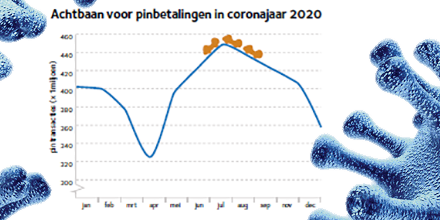
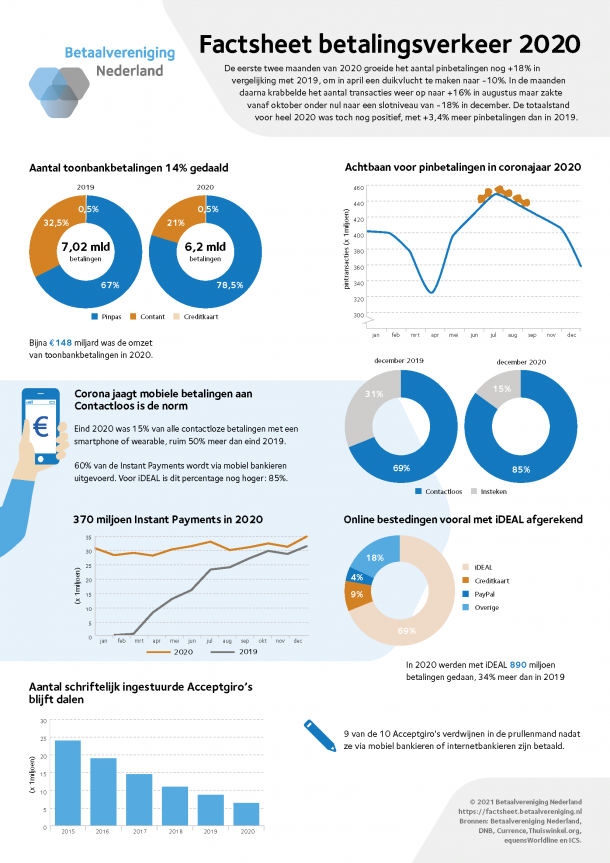
The monthly number of debit card payments(opens in new window) in the COVID-19 year 2020 resembled a rollercoaster ride. In the first two months of the year, the number was still up a spectacular 18% compared with 2019, before diving to -10% in April. Transactions then recovered to +16% in August, but fell below zero from October and ended the year at -18% in December. The total for 2020 nevertheless remained positive, with 3.3% more debit card payments than in 2019.
12% fewer point-of-sale transactions, 2% lower turnover
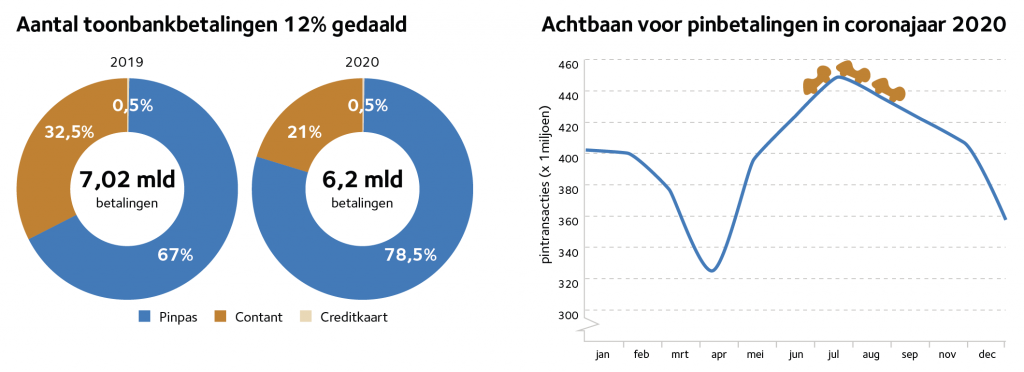
At the end of 2020, around 20% of all point-of-sale payments were made in cash, compared with approximately 30% a year earlier. Because of this sharp decline in cash payments, the estimated total of 6.2 billion checkout transactions was around 12% lower than in 2019. The associated turnover was 2% lower, at an estimated €148 billion.
Contactless payments are the norm
The COVID-19 crisis also led consumers to pay contactlessly much more often. At the end of 2019, fewer than seven in ten debit card payments were contactless (69%). This has now risen to 85%. Around 15% of those contactless payments are made with a smartphone or wearable, more than half as many again as at the end of 2019.
Strong growth in mobile payments
Other mobile payments, for online orders, individual bills, payments between family and friends and second-hand goods, were also boosted sharply by the COVID-19 crisis. In the first full year in which Instant Payments were widely available, 370 million individual instant payments were processed. A new monthly record was set in December, with 35 million instant payments between different banks, compared with 31.5 million a year earlier. An estimated 60% of these instant payments are initiated through mobile banking.
By far the majority of online orders in the Netherlands are paid for with iDEAL, which has a 69% share of the e-commerce market. Around 85% of all iDEAL payments are completed using a mobile banking app, including almost all mobile payment requests such as Tikkies. A total of 890 million iDEAL payments were made in 2020(opens in new window) , 223 million more than in 2019. The value of iDEAL payments was €70 billion, almost €17 billion more than a year earlier.
One quarter fewer Acceptgiro forms
Cash was not the only payment method to decline sharply in 2020: the processing of paper Acceptgiro forms fell by 26%. In 2015, 24 million signed paper Acceptgiro forms were still sent to banks by post. By 2020, this had dropped to just 6.4 million, less than one Acceptgiro per household per year. The number of organisations sending Acceptgiro forms almost halved in 2020, from 16,600 to 9,000.
Nine out of ten Acceptgiro forms end up in the recycling bin after the accompanying invoice has been paid through mobile or internet banking. Organisations that send Acceptgiro forms are therefore rapidly switching to cheaper, more user-friendly and more effective alternatives, such as mobile payment requests, direct debits and QR codes that can be scanned and paid using banks’ mobile apps. For the shrinking group of consumers who still prefer to receive payment details on paper, there is the contract-free Payment Instruction (in Dutch).
Related articles
-
Pay-by-Bank, what is it?
-
News
-
Online payments
-
-
A2A payments continue to grow
-
News
-
Online payments
-
-
Dutch abroad pay most with cards in Spanish hospitality
-
News
-
Card payments
-
-

High confidence in Dutch payment system
-
News
-
Card payments
-
-
Checking In and Out on Public Transportation Is Now Even Smoother with Your Smartphone
-
News
-
Card payments
-
-
Next Phase of iDEAL Migration to Wero Begins in October
-
News
-
Online payments
-