
New VAT rules put the brakes on purchases from China
Following the sharp rise in the second quarter of 2021, online consumer spending and online purchases continued to grow in the third quarter compared with the same period last year.
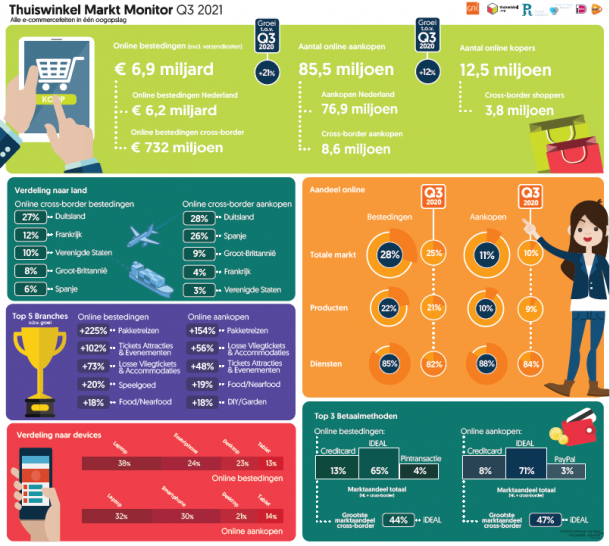
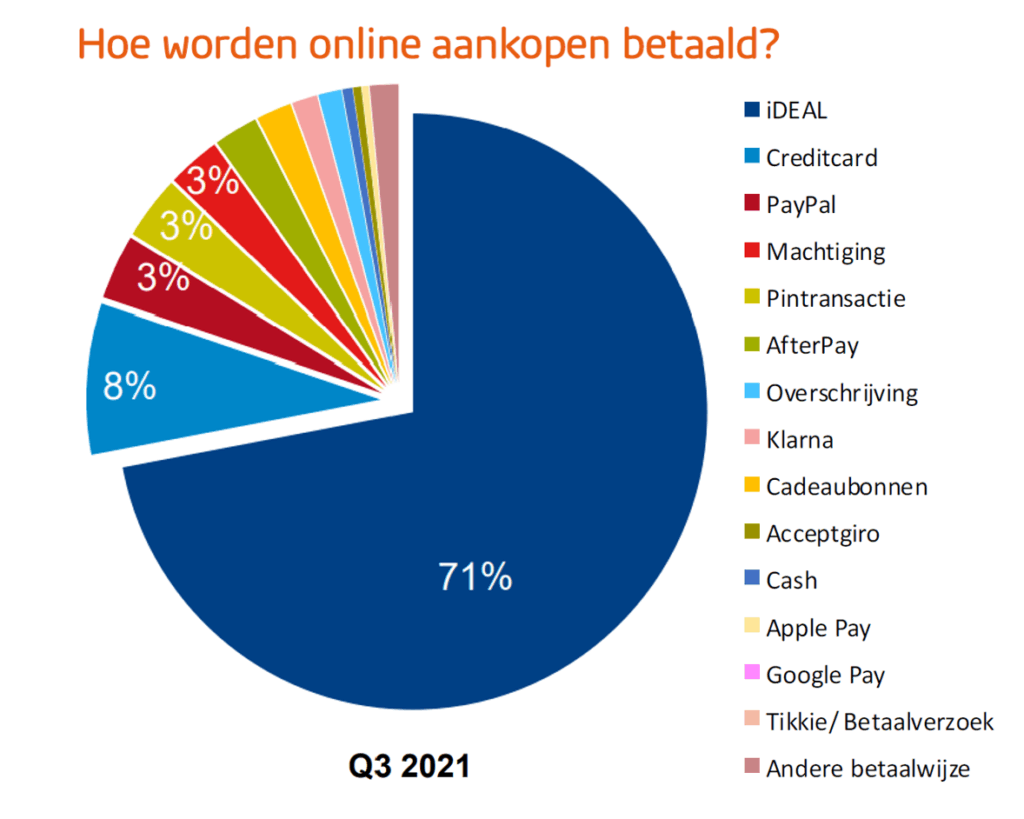
However, at 21 per cent (to €6.9 billion) and 12 per cent (to 85.5 million) respectively, the growth was somewhat more moderate in both cases than in the second quarter of this year. The number of online cross-border purchases continues to fall. In Q3 2021, the number of online cross-border purchases fell by 10 per cent (from 9.5 million to 8.6 million) compared with Q3 2020. Most online purchases are still paid for using iDEAL, followed at some distance by credit cards. In Q3 – just as in the first half of the year – iDEAL’s share actually rose slightly compared with the same period last year, from 69% to 71%. These and other findings are revealed in the latest edition of the Thuiswinkel Market Monitor, the survey of online consumer spending in the Netherlands. This survey is conducted by GfK, commissioned by Thuiswinkel.org and co-commissioner Retail Insiders , and in collaboration with PostNL , the Dutch Payments Association and Currence .
In the third quarter of 2021, 87% of people in the Netherlands aged 15 and over made an online purchase. This is a slightly lower proportion than in the same period last year. However, online shoppers made more purchases on average (12%) and spent more per purchase (8%). As a result, the average amount spent online per online shopper has risen sharply (21%).
Strong growth in services
The growth in total online spending is mainly driven by the strong growth in services (82%). For products, growth was more modest at 6 per cent. Online growth in products therefore appears to be normalising in the third quarter. The number of online purchases rose this quarter, but here too the growth figures for services (47 per cent) are higher than for products (8 per cent). Online penetration for service categories is also significantly higher than a year ago, whilst for most product categories it has actually fallen slightly again. This is particularly the case for IT, Toys and Home & Living – the categories that flourished at the start of the coronavirus crisis. “Overall, we see that the figures are in line with expectations for the third quarter. There is still growth, but understandably less than during the COVID-19 restrictions,” says Marlene ten Ham, director of Thuiswinkel.org.
Travel and events record strongest growth
In Q3, nearly three times as many package holidays were purchased online, whilst individual flight tickets & accommodation and tickets for attractions & events saw growth of 56 per cent and 48 per cent respectively compared with the third quarter of last year. Online spending on package holidays also grew by no less than 225 per cent, whilst tickets for attractions and events rose by 102 per cent.
In absolute terms, the product categories Food/Near-food (19%) and DIY/Garden (18%) also showed strong growth in online purchases. These remain the categories with the highest number of online purchases in Q3 2021. Many product categories are seeing growth in online spending; only Home & Living shows a 14% decline compared with Q3 2020. This is striking, given that this category actually saw a strong rise in online spending in the first half of 2021.
Impact of new VAT rules on spending at Chinese online shops
Although online cross-border purchases continued to fall in Q3 compared with the same quarter last year, online cross-border spending, by contrast, rose by 30% (from €565 million to €732 million). This is because cross-border spending is also benefiting from the enormous growth in online spending on services. A quarter of total online spending on individual flight tickets and accommodation in Q3 2021 was spent on a foreign website. This was mainly on websites based in France or Germany. The travel sector is now driving cross-border spending.
Cross-border products
Spending on products purchased online across borders fell by 6% in the third quarter compared with Q3 2020. In particular, spending on products from Chinese websites fell this quarter (from 14% to 10%). The new VAT rules, which came into force on 1 July and apply to parcels from online shops outside the EU, are therefore having a dampening effect. Ten Ham: “From 1 July, VAT must be paid on all goods from outside the EU that are delivered directly to private individuals in an EU country, regardless of the value of the consignment. This has resulted in the abolition of the import VAT exemption for products up to and including €22. We are clearly seeing the effect of this in Q3. The level playing field that the EU is creating here for all sellers both within and outside the EU is a positive development for the Dutch online retail sector.”
Related articles
-

Pay-by-Bank, what is it?
-
News
-
Online payments
-
-
A2A payments continue to grow
-
News
-
Online payments
-
-

Dutch abroad pay most with cards in Spanish hospitality
-
News
-
Card payments
-
-

High confidence in Dutch payment system
-
News
-
Card payments
-
-

Next Phase of iDEAL Migration to Wero Begins in October
-
News
-
Online payments
-
-

Lower travel spending is putting pressure on overall online spending
-
News
-
Online payments
-