
Milestone: debit cards overtake cash in the Netherlands
In 2015, consumers in the Netherlands paid for more purchases by debit card than in cash for the first time. On average, they paid for half of their purchases at shops, petrol stations, hospitality venues and other locations by debit card, 49.5% in cash and 0.5% by credit card.
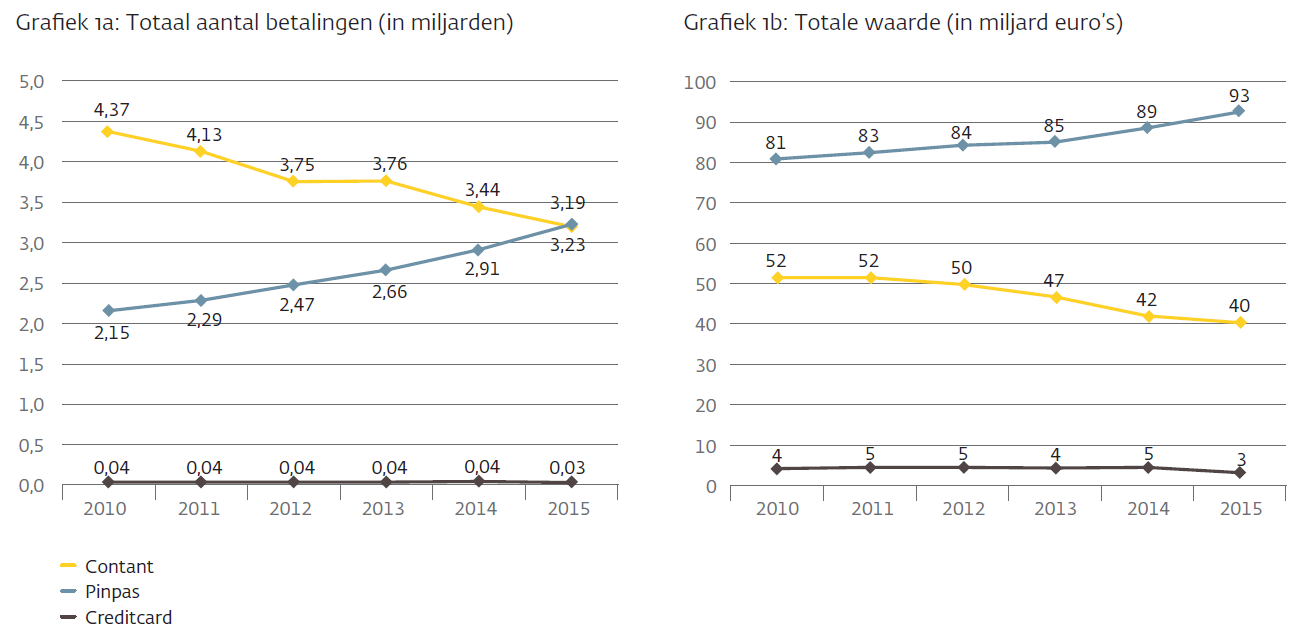
This is shown by joint research conducted by the Dutch Payments Association and De Nederlandsche Bank into the use of cash and debit cards in the Netherlands in 2015.
Between 2014 and 2015, the number of cash payments made by consumers at the point of sale fell from 3.44 billion to 3.19 billion. Their total value decreased from €42 billion to €40 billion.
Consumers increasingly paid for their purchases by debit card. The number of debit card payments rose from 2.91 billion to 3.23 billion, 40 million more than the number of cash payments. The total value of debit card payments increased from €89 billion to €93 billion.
Consumers increasingly use debit cards even for the smallest purchases
Traditionally, consumers mainly used their debit cards for larger amounts, while paying for smaller purchases in cash more often. In recent years, there has been a clear shift towards debit card payments for even the smallest purchases. In 2010, consumers used a debit card for 11% of purchases below €5; by 2015, this had risen to 30%. Alongside the withdrawal of Chipknip on 1 January 2015, the introduction of contactless payments (in Dutch) in 2014 may have contributed to this. Consumers make these payments by holding their debit card or mobile phone close to the payment terminal. For amounts up to and including €25, they do not even need to enter a PIN. This makes paying easier and faster.
Debit card payments also overtake cash in supermarkets
Between 2010 and 2015, the share of debit card payments increased in every sector, while the share of cash payments fell. How consumers pay varies by sector and depends strongly on the amount due. In supermarkets, where a relatively large proportion of all payments are made, consumers paid for their groceries by debit card more often (53%) than in cash (46%) for the first time in 2015. In 2010, they still paid for 60% of their groceries in cash.
The shift towards debit card payments over the previous five years was strongest in sectors where consumers had traditionally paid mainly in cash, such as vending machines for snacks, soft drinks and cigarettes (+44 percentage points) and hospitality venues (+27 percentage points). The withdrawal of Chipknip and introduction of contactless payments helped increase the share of debit card payments in the hospitality sector.
In 2015, consumers still used cash frequently for purchases on the street, for example from an ice-cream seller or at a market, at specialist food and drink shops and in the leisure sector. However, they also used debit cards at these locations more and more often.
Teenagers and people aged over 75 often pay in cash
As in previous years, young adults aged 19–34 and people with a higher level of education used debit cards relatively most often. Teenagers and people aged over 75 still paid in cash comparatively often: for two out of every three purchases. However, debit card use among these two consumer groups had clearly increased over the previous five years; among people aged over 75, it had more than doubled.
Cash use was lowest among consumers aged 19–34: they paid for fewer than four out of ten purchases in cash.
More debit card payments improve security and efficiency
The shift in consumer payment habits from cash to electronic payments at the point of sale offers social benefits, including greater security and lower costs. Banks and retailers agreed to work together to encourage consumers to use debit cards. Their target was for consumers to pay for 60% of purchases by debit card and 40% in cash by 2018. As consumers paid for 50% of their purchases by debit card in 2015, debit card use needed to grow by more than three percentage points a year over the following three years. This would be possible if the growth of previous years continued. Although cash use was declining, the National Forum on the Payment System (NFPS) considered it important for accessibility and financial stability that cash continued to function properly as a means of payment at the point of sale, for both consumers and businesses.
For all the findings of the joint research by DNB and the Dutch Payments Association into the use of cash and debit cards in the Netherlands in 2015, download the factsheet ‘Payments at the point of sale 2015’ (in Dutch). The factsheet contains information about cash and debit card use in general and by transaction amount, sector and demographic characteristics, as well as seasonal developments in payment behaviour. It also includes information about contactless payments by purchase amount and sector.
Related articles
-
Dutch abroad pay most with cards in Spanish hospitality
-
News
-
Card payments
-
-
Tackling ATM attacks with ink, glue and synthetic DNA
-
News
-
Cash payments
-
-

High confidence in Dutch payment system
-
News
-
Card payments
-
-
Make digital euro useful, simple and affordable
-
News
-
European legislation
-
-
Cash accepted at 96% of points of sale
-
News
-
Cash payments
-
-
Vote on the Design of New Euro Banknotes
-
News
-
Cash payments
-