
Dutch Payments Association publishes 2014 Annual Report
SEPA implementation completed, focus on innovation
For the Dutch Payments Association, 2014 was dominated by the final implementation of SEPA, the Single Euro Payments Area. Moving national payments to a shared European infrastructure was an operation comparable in scale and importance to the introduction of the euro. With the migration to SEPA successfully completed, the Dutch Payments Association and its members could focus on further innovation in payments.
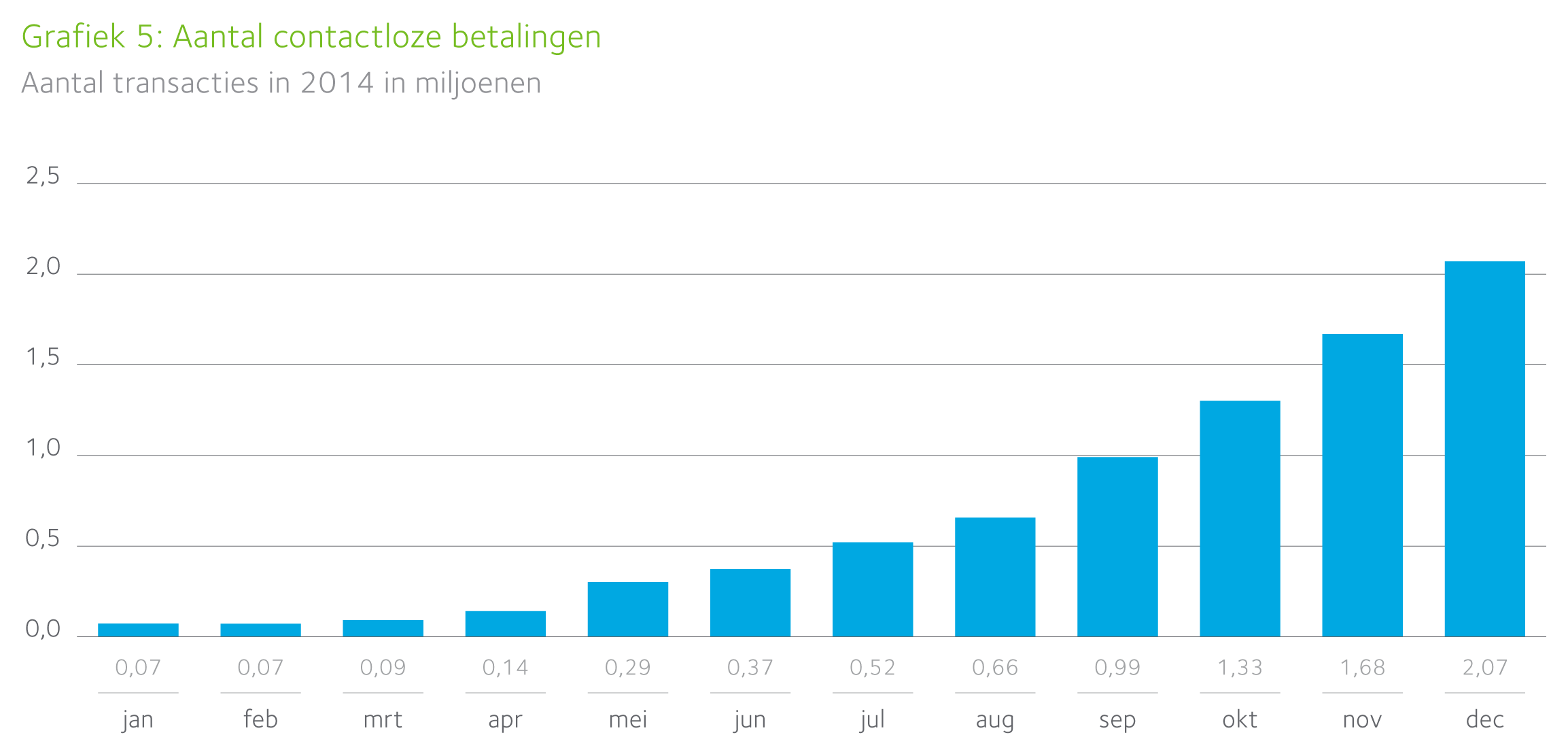
Continued growth and greater convenience in electronic payments
Electronic payments at the point of sale rose sharply again in 2014. Several innovations were introduced: mobile payment terminals, debit card refunds, ‘dip & go’ at parking terminals and contactless payments by debit card and mobile phone. Strong growth was expected in secure and fast contactless payments in the years ahead. A quarter of all payment terminals and more than 10 million debit cards and mobile phones already supported contactless payments. These developments were expected to result in people in the Netherlands paying by debit card more often than in cash before 2020.
More and more online shops and service providers offered iDEAL payments on smartphones and tablets through banks’ apps or mobile websites. Consumers in the Netherlands could also use iDEAL securely and easily at an increasing number of foreign online shops.
Payments 2.0
Society was digitalising rapidly. Under the name Payments 2.0, the Dutch Payments Association worked with banks and payment institutions to develop a new payment infrastructure in response. The Dutch Payments Association played a connecting role to promote the efficiency, stability, security and accessibility of payments.
In 2014, the Dutch Payments Association and the banks prepared for the introduction of the Digital Mandate Service. The first consumers could now use their own bank’s familiar internet banking environment to issue mandates to direct debit users.
Two concrete projects were already under development: real-time payments and electronic identification. The banks intended consumers to be able to use their own bank’s electronic identification method to log in to the websites of shops and companies during 2016, in the same way as with internet banking. “This gives tangible substance to online companies’ and organisations’ aim of one-click shopping, in which ordering and paying online form a seamless process,” said Piet Mallekoote, director of the Dutch Payments Association.
During 2019, the banks would begin offering real-time payments, allowing a payment to reach the beneficiary’s bank account within seconds. Piet Mallekoote emphasised the scale of the project: “Under the coordination of the Dutch Payments Association, the banks are developing a completely new platform for real-time account-to-account payments. This month, the Dutch Payments Association began consulting all parties with an interest in the project, including umbrella organisations representing consumers, businesses and payment service providers.”
Download the Dutch Payments Association’s full 2014 Annual Report.
Download Currence’s full 2014 annual overview (in Dutch).
Related articles
-
Pay-by-Bank, what is it?
-
News
-
Online payments
-
-
A2A payments continue to grow
-
News
-
Online payments
-
-
Dutch abroad pay most with cards in Spanish hospitality
-
News
-
Card payments
-
-

High confidence in Dutch payment system
-
News
-
Card payments
-
-
Checking In and Out on Public Transportation Is Now Even Smoother with Your Smartphone
-
News
-
Card payments
-
-
Next Phase of iDEAL Migration to Wero Begins in October
-
News
-
Online payments
-