
Dutch consumers spent €33.3 billion online in 2022
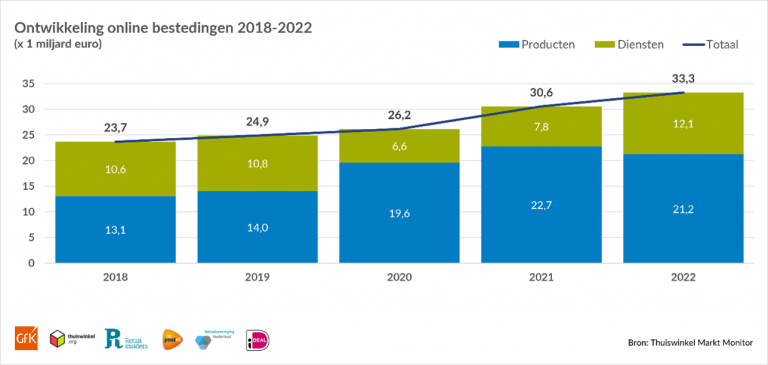
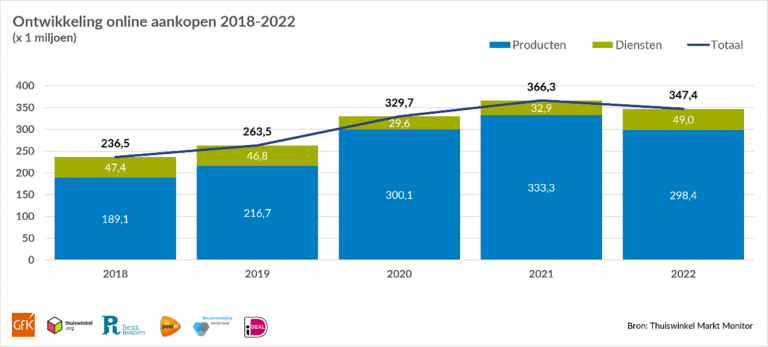
Dutch consumers spent €33.3 billion online in 2022, up 9% compared with 2021. This increase in spending is striking, as the number of purchases actually fell by 5% to 347 million. The average amount spent online per purchase therefore rose by 15%. These are the latest figures from the Thuiswinkel Markt Monitor, a study of online consumer spending in the Netherlands. GfK conducts the study on behalf of Thuiswinkel.org and Retail Insiders, in cooperation with PostNL, the Dutch Payments Association and Currence.
Growth in online service purchases, decline in products
The share of people in the Netherlands who order online remained unchanged over the past year: 97% of the Dutch population shops online. In 2022, the number of online service purchases and the amount spent on services rose by 49% and 54% respectively, while the number of product purchases and the amount spent on products fell by 10% and 7%. Online spending on services grew particularly strongly in the first quarter (+125%) and fourth quarter (+49%) of 2022 compared with 2021.
This can partly be explained by the difference in market conditions: there was no lockdown in the fourth quarter of 2022, whereas there was one in the fourth quarter of 2021, together with associated travel restrictions. The lockdown in the first quarter of 2022 was also shorter than in the first quarter of 2021. Dutch consumers therefore made more purchases in the services category. New crises did emerge, however: the war in Ukraine, the energy crisis and high inflation. “The increase in the services sector was driven mainly by the many purchases of tickets for attractions and events and by travel-related purchases. We also bought insurance online more often in 2022 than in 2021, and at a higher price,” says Marlene ten Ham, managing director of Thuiswinkel.org.
Online share of total purchases edged down
The decline in the number of online product purchases and the amount spent on products was visible in every quarter of the year. “The contraction in products applies to every category except food and near-food products (+3% compared with 2021). Growth in the number of households shopping online and the amount spent per online purchase means this category continues to grow steadily. Online grocery shopping remains popular in the Netherlands, which is reflected in online purchases and spending in this category,” says Ten Ham.
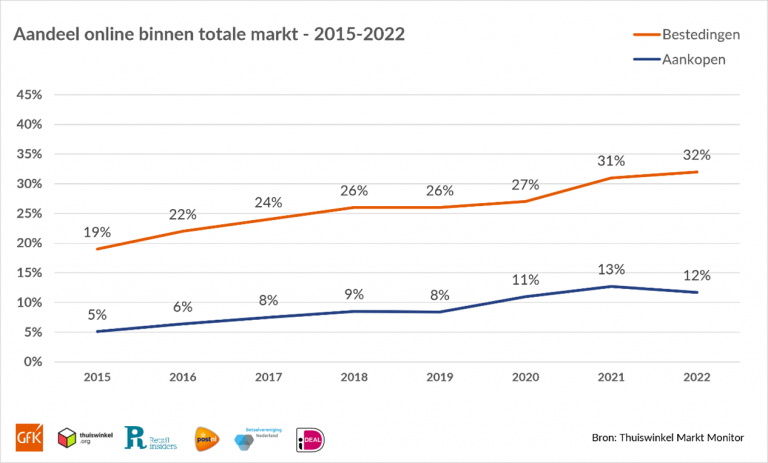
Purchases shifted slightly towards physical retail. In 2021, 13% of all purchases were made online, but this fell to 12% in 2022. By contrast, the online share of total spending rose from 31% to 32%. This can again be explained by the absolute increase in spending on services. We are therefore buying products and services in physical shops slightly more often again, but we often spend more on services purchased online. “The online share of both purchases and spending remains higher than in 2019, before the coronavirus pandemic, and even than in 2020, during the pandemic,” says Ten Ham.
More online spending abroad
Online purchases from abroad show the same trend as online purchases within the Netherlands: the number of purchases fell by 5% compared with 2021, while spending rose by 20%. This rise was driven mainly by growth in spending on package holidays (+164%) and individual airline tickets and accommodation (+74%) purchased abroad, particularly in the United States, Austria, Great Britain and Germany.
Growing use of smartphones and iDEAL
The use of smartphones for online orders has grown sharply in recent years. In 2022, the share of online purchases made by smartphone rose from 29% to 33%. “Looking at the growth in smartphone use over the past five years provides an even clearer picture: in 2017, only 13% of online purchases were made by smartphone. Five years later, smartphone use has increased two-and-a-half times,” says Ten Ham.
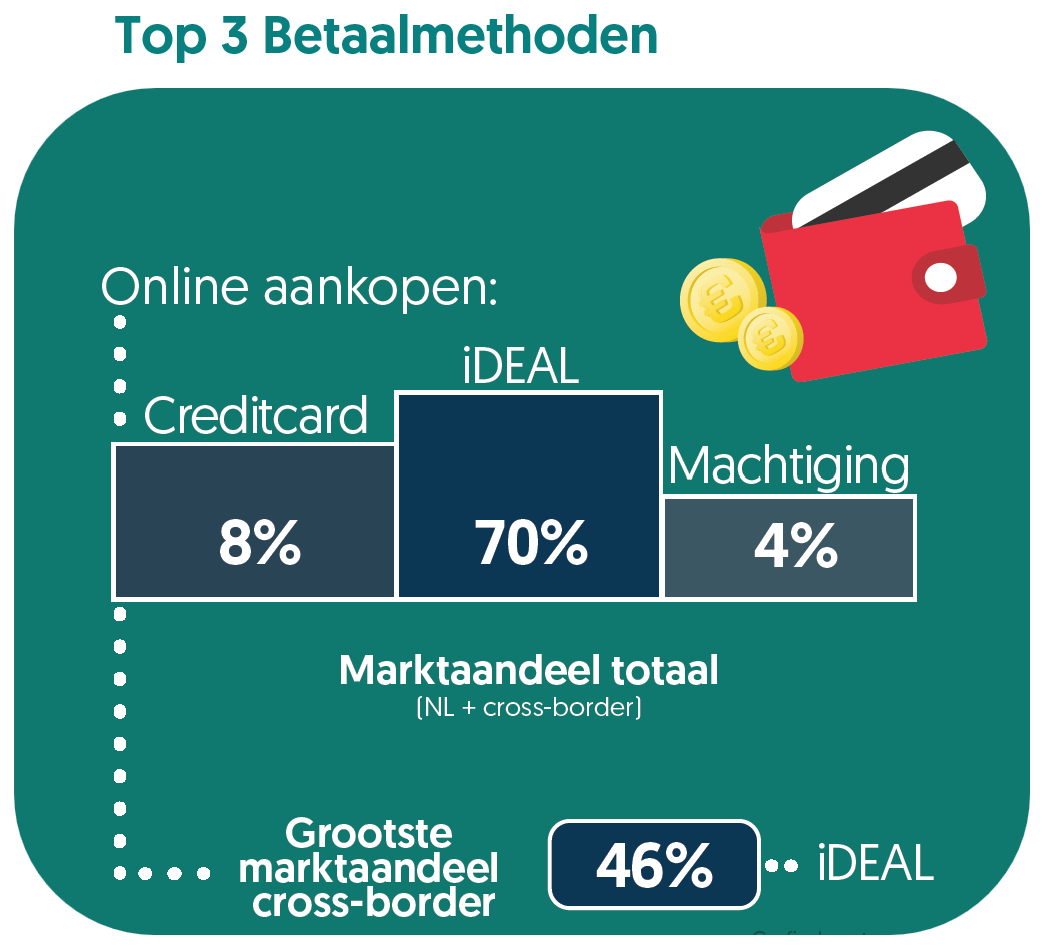
iDEAL remained the most widely used payment method for online purchases. It was used for 70% of online purchases, the same percentage as in 2021. iDEAL also had the most users: 96% of online shoppers used this payment method at least once in 2022. Services are often purchased by credit card, and because spending on and purchases of services rose sharply, the share of consumers who used a credit card also increased compared with 2021, from 28% to 31%. AfterPay/Riverty saw its share of users fall from 23% to 19%.
Related articles
-
A2A payments continue to grow
-
News
-
Online payments
-
-
Dutch abroad pay most with cards in Spanish hospitality
-
News
-
Card payments
-
-

High confidence in Dutch payment system
-
News
-
Card payments
-
-
Next Phase of iDEAL Migration to Wero Begins in October
-
News
-
Online payments
-
-

Lower travel spending is putting pressure on overall online spending
-
News
-
Online payments
-
-

The Digital Euro and Stablecoins: Apples and Oranges
-
News
-
European legislation
-