IBANs

Since 2014, the International Bank Account Number (IBAN) has been the international standard for payments accounts in Europe. The IBAN identifies each payments account in a unique and unambiguous way and forms the basis for domestic and cross-border payments. Uniform European and international agreements minimize the risk of errors in account numbers.
Structure of the IBAN
Each country has its own predefined IBAN structure. The standard for this structure is laid down in ISO 13616(opens in new window) and included for each country in the IBAN Registry(opens in new window) .
The Dutch IBAN consists of 18 characters and is structured as follows:
- NL – the country code
- 2 digits – check digit
- 4 letters – code of the payment service provider
- The former Dutch account number (maximum 10 digits)
The Dutch IBAN for bank account number 123456789 is therefore as follows:
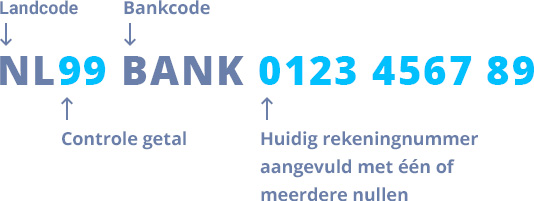
Since July 1, 2020, multiple Dutch IBANs can have the same 10 digits at the end. The payment institution code (positions 5–8) ensures that each IBAN remains unique.
The accuracy of an IBAN can be checked using a mathematical verification formula, which makes the chance of typing errors very small.
Use and payments
All IBANs can be used for:
- domestic payments
- cross-border payments
For transactions outside the European Union, the BIC is required in addition to the IBAN. Within the EU, in most cases it is no longer necessary to state the BIC.
Legislation
The Dutch Tax Administration must be able to verify that the correct IBAN is stated in the records.
The legal definition of an IBAN is:
“An identification number for an international payments account, which uniquely identifies an individual payments account in a member state, and whose elements are defined by the International Organization for Standardization.”
The use of IBAN is laid down in the SEPA Regulation(opens in new window) and the PSD2 Directive(opens in new window) .
From October 9, 2025, payment service providers must check that the name and IBAN match before confirming a transfer within the eurozone. In the Netherlands, this is done via the IBAN Name Check.
IBAN discrimination is prohibited(opens in new window) . An organization that accepts a Dutch IBAN must also accept IBANs from all other countries in the European Economic Area. DNB offers information and a reporting center for situations where this does not happen.