
Payment terminals
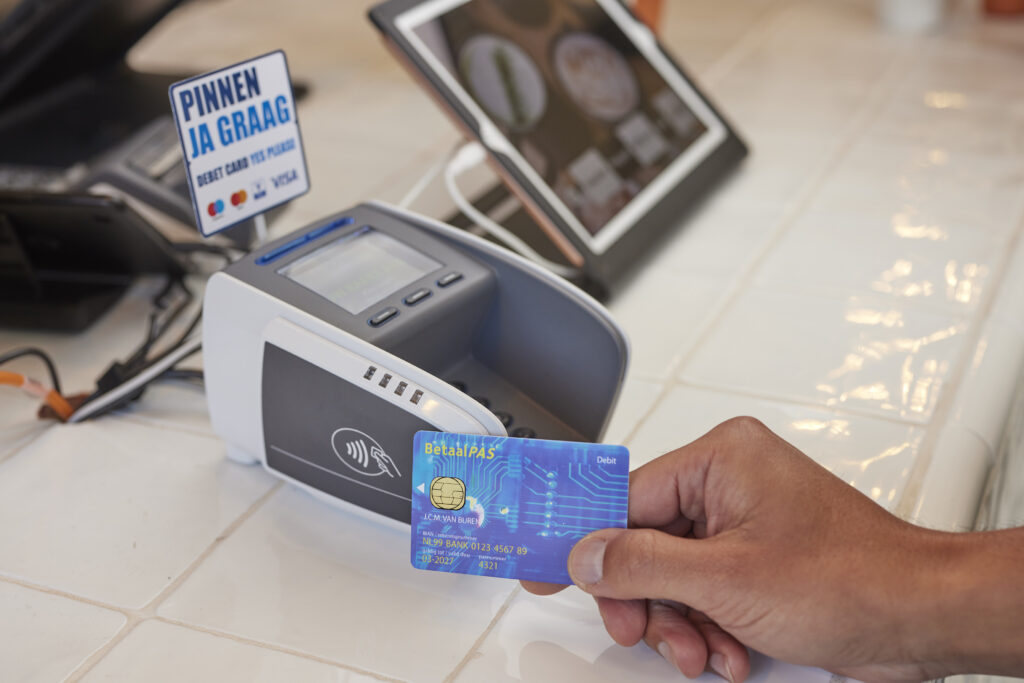
Types of payment terminals
Payment terminals vary greatly in design and capabilities. The choice of terminal type depends on how the merchant wants to process payments. Important considerations are:
- Fixed or mobile payment terminal
- Connection via network cable, WiFi, or 4G/5G
- Standalone or linked to a cash register system
- With or without receipt printer
- With keyboard or touchscreen
These choices determine the flexibility, speed, reliability, and costs for the merchant.
Services related to payment terminals
Suppliers of payment terminals offer additional services and contract types that allow merchants to set up their payment process. Factors that play a role include:
- Rent or buy
- Service contract included/not included
- Purchase terminal separately or as part of a debit card package
- Support for e-commerce or m-commerce,
for merchants who accept payments both online and at the point-of-sale - Back-office integration for reconciliation
- Loyalty and marketing services
The options vary per supplier and acquirer.
Standards for payment terminals
The choice of a payment terminal can impose restrictions on the cash register system and the debit card contract, especially in the case of solutions that are tied to a single supplier. Standardization helps prevent vendor lock-in.
C-TAP (Netherlands/Benelux)
In the Netherlands, C-TAP is the dominant messaging protocol between payment terminals and acquirers/transaction processors. It is an open, multi-acquiring protocol that allows merchants to easily switch acquirers without having to purchase a new terminal. The terminal can also be connected to multiple acquirers at the same time, allowing customers with different payment cards from different card schemes and types to pay via the same terminal.
C-TAP is mainly used in the Benelux. This can pose limitations for international merchants who also operate outside the Benelux and want to use the same terminals everywhere.
Nexo (European ambition)
Nexo is based on ISO 20022 and aims to become the European standard. Most implementations are currently in French retail. Outside France, there are still few terminals with Nexo acquiring or Nexo cash register connections.
Cash register connections
There are virtually no international standards for cash register connections. Connections are usually developed bilaterally between the cash register supplier and the terminal supplier. Nexo offers a retail protocol, which has been adopted by Adyen, among others.
Certification
International card schemes (Mastercard, Visa, AmEx, etc.) require payment terminals to comply with certain security and interoperability standards. To prove that a terminal complies with these standards, it must be certified. Important certifications include:
PCI PTS certification
The PTS PIN Transaction Security standard is managed and certified by the Payment Card Industry Security Standards Council or PCI SSC.
- Focuses on the secure entry and processing of PIN codes on terminals
- The PCI PTS certificate has an expiry date for each type of terminal;
- after that date, that type may no longer be sold but may still be used
EMVCo certifications
EMVCo was originally founded by Eurocard, Mastercard, and Visa. Other card schemes have since joined EMVCo, including American Express and China’s UnionPay. EMVCo manages and certifies various standards for payment cards and payment terminals. For payment terminals, three certification levels are important: Level 1, Level 2, and Level 3.
- L1 – communication standard between chip card and terminal
- L2 – so-called kernel software (per scheme for contactless)
- L3 – connection to the transaction processor’s infrastructure
An acquirer may require additional certification, such as for C-TAP terminals.
These certifications are not particularly relevant for Dutch merchants: suppliers of payment terminals connected by Dutch acquirers supply standard terminals that meet all requirements. Anyone who wants to buy a payment terminal anywhere must first ask their acquirer whether they can actually connect the intended terminal.
Laws and regulations for payment terminals
CE marking
Every terminal must have a CE marking, which indicates that the manufacturer certifies that the device is safe and has no harmful effects on health or the environment.
EAA: European Accessibility Act
New payment terminals must meet accessibility requirements, including:
- Perceivable by at least two different senses, such as sight or hearing
- Customizable display and sufficient contrast
- Warning signals with sound and tactile vibrations
- Sufficient operating time for people with motor impairments
- Option for tactile number and control keys
New terminals must comply with the EAA. Terminals already in use prior to July 2025 do not need to be replaced. It is not yet clear whether older terminals that do not comply with the EAA may still be repaired and/or updated with new software or security patches. The RDI will have to provide a definitive answer on this matter.
The National Inspectorate for Digital Infrastructure (RDI)(opens in new window) oversees compliance with the EAA for payment terminals, among other things. The RDI also operates a consumer complaint center(opens in new window) where complaints about inaccessible products can be filed.
Merchants are advised to explicitly ask the supplier whether a new payment terminal complies with EAA regulations when purchasing one.
Evolution of payment terminals
Originally, payment terminals were very closed systems: specific hardware, their own operating system, and only an EMV payment application. Nowadays, some payment terminals are complete store systems with a counter and payment terminal in one handy mobile device.
Android terminals
- Support apps for additional functions such as loyalty programs, product catalogs, and new checkout concepts.
- Makes “the counter comes to you” possible.
SoftPOS
SoftPOS turns a regular smartphone or tablet into a payment terminal thanks to a payment app from the acquirer.
- Low entry costs
- Always have your payment terminal with you
Payment apps on regular smartphones are more susceptible to fraud than closed terminals. That is why strict PCI MPOC requirements apply, including a mandatory monitoring and detection system to identify security risks in a timely manner.
Perspective on payment terminals
As long as debit card payments remain the dominant payment method at the point-of-sale, payment terminals will remain necessary. Further digitization will increase the use of mobile multifunctional and SoftPOS payment terminals, especially when merchants replace their old terminals. These new solutions are more flexible and make integration with other applications easier.