
Consumers spent more than €30 billion online in 2021
Dutch consumers spent €30.6 billion online in 2021, an increase of 16% compared with 2020. They made 373 million online purchases, representing growth of 13% compared with 2020.
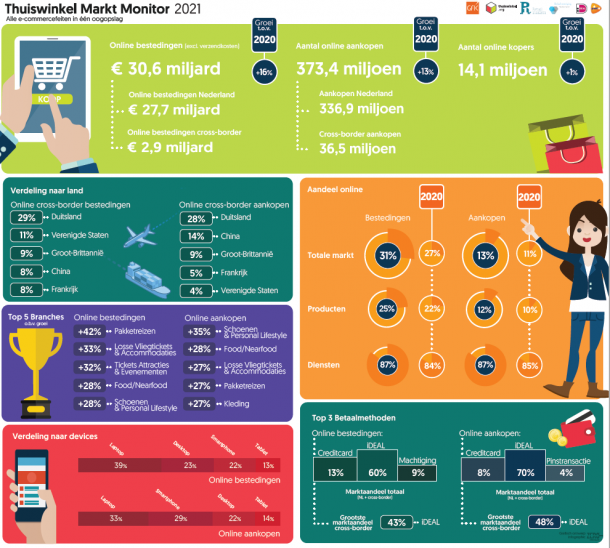
Online therefore accounts for 31% of total spending. This is shown by the latest figures from the Thuiswinkel Market Monitor, the study of online consumer spending in the Netherlands. GfK conducts the study on behalf of Thuiswinkel.org en Retail Insiders and in collaboration with PostNL , the Dutch Payments Association and Currence .
COVID-19 effect or lasting trend?
Growth in online spending was 3% in 2019 (before the COVID-19 outbreak) and 6% in 2020, but rose to 16% in 2021. Growth in online purchases was 7% in 2019, peaked at 26% in 2020 and remained high at 13% in 2021. Both pandemic years therefore show stronger growth in online purchases, but only 2021 also shows stronger growth in online spending. “Online growth was fuelled once again by the COVID-19 measures, such as the closure of non-essential shops in the first quarter and at the end of the fourth quarter. As a result, consumers again made more online purchases this year. Notably, the total amount spent online per consumer also increased, from €1,900 to €2,180, a rise of 15%. Consumers are therefore becoming accustomed to spending increasing amounts online. We expect consumers to continue buying online this year, but for growth to return to its pre-pandemic pattern,” says Marlene ten Ham, managing director of Thuiswinkel.org.
Growth shifts between products and services
Online purchases of products increased by 13% in 2021. Consumers still bought products online in large numbers in the first quarter (+43%). The product sector recorded modest growth of 5% and 8% in the second and third quarters, while the fourth quarter even saw a contraction of 1%. Services show the opposite picture. Online purchases in this sector were still down sharply in the first quarter (-52%), but services began to recover in the second quarter as travel restrictions eased. In the fourth quarter, services collectively recorded a 63% increase in online purchases. “The explosive growth figures seen in the product sector last year and in the first quarter of this year shifted to the service sector from the third quarter onwards. During lockdowns, purchases of products increase; when restrictions are eased, purchases of services increase instead,” says Ten Ham.
This does not mean that the service sector has fully recovered. Ten Ham explains: “In absolute terms, the service sector remains below its pre-pandemic level. Online spending on services was €7.8 billion this year, compared with €10.8 billion in 2019. However, the sector has been recovering strongly since the fourth quarter. We expect this growth to continue in 2022 and online spending on services to exceed the 2019 level.”
Online share of total spending rises to 31%
The shift from offline to online continued in 2021. Online’s share of total purchases increased further to 13% (2020: 11%, 2019: 8%). The online share of total spending also increased on an annual basis, from 27% to 31%. This rise is mainly due to growing online spending on products.
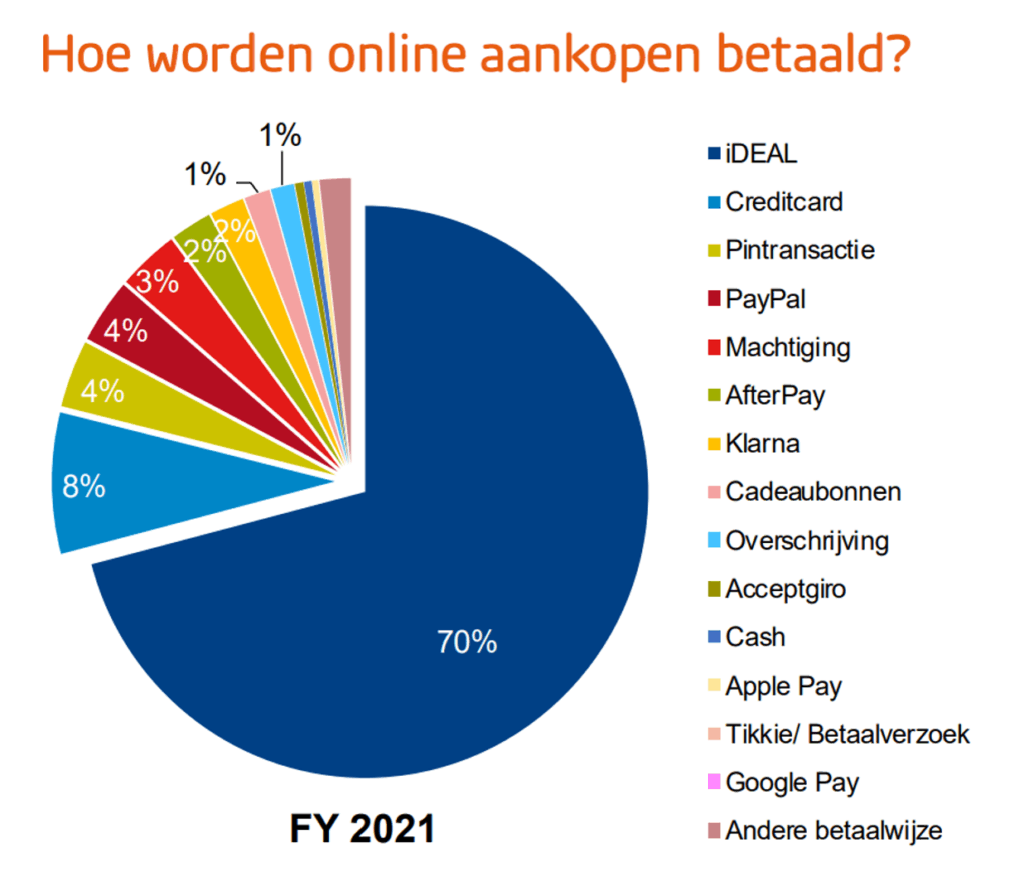
The importance of the smartphone increased again this year. Almost one third of all purchases (29%) were made using a smartphone, compared with 25% in 2020. By far the largest number of purchases were paid for using iDEAL. iDEAL’s share as a payment method for online purchases increased slightly again this year, from 69% in 2020 to 70% in 2021. Apple Pay recorded the strongest growth, at 73% (from a 0.2% share in 2020 to 0.4% in 2021).
Strong demand for holidays and days out
With the exception of DIY/Garden, Insurance and Sports & Recreation, every sector recorded growth in both online purchases and online spending. Package holidays saw the strongest rise in online spending (+42%), followed by individual airline tickets and accommodation (+33%) and tickets for attractions and events (+32%). “The decline in the DIY/Garden and Sports & Recreation categories can be explained by their strong growth in 2020. During the first lockdown, consumers bought large numbers of products to improve their homes and exercise at home, so demand for these products was lower in 2021. Since restrictions were eased in the second quarter, consumers have had a strong desire to go out. As a result, leisure spending on travel and tickets has risen sharply this year,” says Ten Ham.
Online grocery shopping also became more popular. This is reflected not only in 28% growth in online spending, but also in an increase in online’s share of spending from 6% to 8%. More households bought groceries online (2.4 million in the fourth quarter), and the number of online purchases per buying household also increased (6.5 purchases in the fourth quarter).
9 out of 10 purchases through domestic websites
Domestic websites accounted for 90% of online purchases, compared with 88% in 2020. Online cross-border spending increased (+14%), but the number of purchases declined (-5%). This applies mainly to products rather than services, for which the cross-border share of online purchases rose slightly (from 8.5% to 9.0%). China and the UK were the main countries to see a decline in their share of cross-border purchases.
Related articles
-

High confidence in Dutch payment system
-
News
-
Card payments
-
-
Next Phase of iDEAL Migration to Wero Begins in October
-
News
-
Online payments
-
-

Lower travel spending is putting pressure on overall online spending
-
News
-
Online payments
-
-

The Digital Euro and Stablecoins: Apples and Oranges
-
News
-
European legislation
-
-
Banks are calling out social media platforms for their role in fraud and scams
-
News
-
Online payments
-
-

First online lunch session updates members on current developments in the payments sector
-
News
-
European legislation
-