
Online spending by Dutch consumers grows by 7% to €8.2 billion in Q1
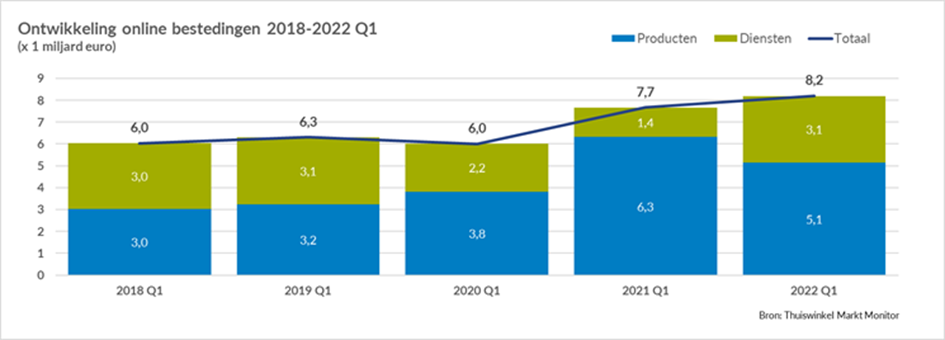
Online spending by Dutch consumers totalled €8.2 billion in Q1 2022, an increase of 7% compared with the lockdown quarter of Q1 2021. Growth was driven by the strong recovery in services (+125%), bringing spending on services back to pre-pandemic levels.
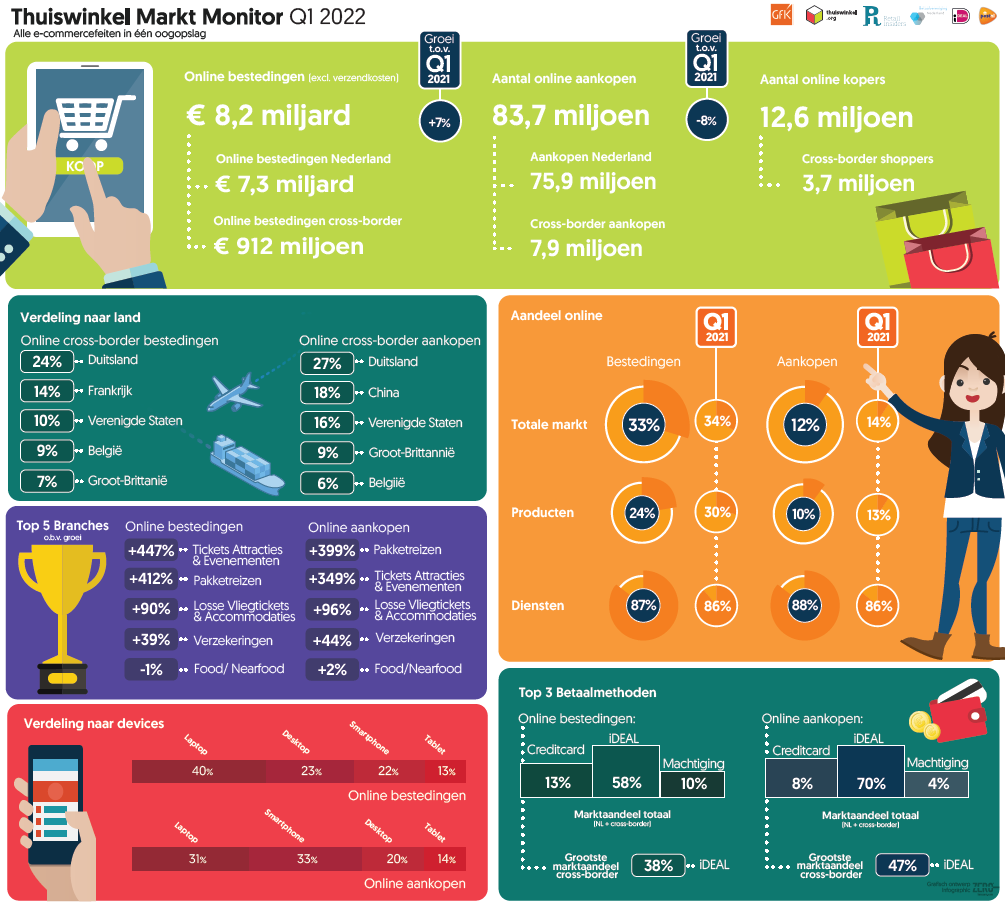
Spending on products fell compared with Q1 2021, but remained above pre-pandemic levels. Online spending on products contracted by 18% this quarter. Even so, it was still higher than in Q1 2020 and Q1 2019. These are the latest findings from the Thuiswinkel Market Monitor, which tracks online consumer spending in the Netherlands. The survey is conducted by GfK on behalf of Thuiswinkel.org and Retail Insiders, in collaboration with PostNL, the Dutch Payments Association and Currence.
Marlene ten Ham, managing director of Thuiswinkel.org: “From 10 January, the Netherlands gradually reopened. This brought the huge pandemic peaks in online ordering to an end. Even so, we are not returning entirely to the previous growth curve. Before the pandemic, growth in online spending in Q1 appeared to be levelling off, whereas it is now back at 7%. Taking Q1 2019 as the baseline, online spending in Q1 2022 was 30% higher.”
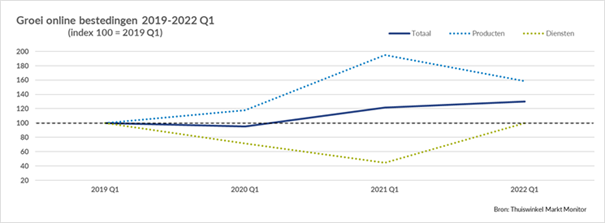
Services return to pre-pandemic levels after COVID-19 dip
Following a strong fourth quarter in 2021, the recovery in services was also clearly visible at the start of 2022. The number of online purchases and the amount spent online quadrupled in both the package holidays and tickets for attractions and events categories. The survey also showed that consumers spent more on average in these categories. “Despite the lockdown at the beginning of the year, consumers were confident that they would be able to travel again this spring and summer. We expect this growth to continue in Q2 as more last-minute travellers make their bookings,” Ten Ham said.
Online spending on products falls but remains above the projected pre-pandemic trend
All categories saw online spending decline. Only Food/Nearfood and Media & Entertainment recorded modest growth in online purchases, of 2% and 1% respectively. Ten Ham said: “In Media & Entertainment, we have seen new streaming services such as Viaplay and HBO Max enter the Dutch market. In Food/Nearfood, the upward trend in online purchases has continued because more households began buying online during the various lockdowns. This is also reflected in online spending: although Food/Nearfood contracted by 1% compared with Q1 2021, spending was 125% higher than in Q1 2019 and 81% higher than in Q1 2020.”
Ten Ham continued: “The growth in products compared with pre-pandemic levels is clearest when looking at absolute online spending. Consumers spent €3.2 billion on products in Q1 2019; during the lockdown, this peaked at €6.3 billion, and the figure now stands at €5.1 billion. That is still €2 billion more than just three years ago. Spending on services returned to its pre-pandemic level of €3.1 billion this quarter.”
One in three online purchases made by smartphone
The use of smartphones for online shopping continues to grow. One in three online purchases in Q1 2022 was made using a smartphone. Smartphone use increased particularly in the Food/Nearfood and Media & Entertainment categories. Desktop and laptop computers remained important for online purchases, with a combined share of 51%.
Cross-border purchases fall while spending rises
The number of online cross-border purchases continued to fall (-11%), driven by a 21% decline in cross-border product purchases. Online cross-border spending rose by 44%, supported by strong growth in cross-border spending on services (+302%). More than a quarter of online spending on standalone airline tickets and accommodation was booked through foreign websites in Q1 2022, particularly French and German sites. This was an increase of 68% compared with Q1 2021.
iDEAL remains by far the most widely used payment method
iDEAL was still used for 70% of online purchases, accounting for 47% of online spending. Apple Pay recorded the strongest growth in online spending. Although its share of total e-commerce spending remained below 1%, spending via Apple Pay grew by 244%. This was largely driven by increased use for purchases in the Food/Nearfood sector, one of the largest categories. The use of iDEAL for online cross-border purchases fell slightly this quarter in favour of credit cards, as consumers spent heavily on travel through foreign online shops and these purchases are often paid for by credit card.
-
-
-
-
-
-
-
-
-
-
-
Download: Example traffic light forms for one-time SEPA direct debit (in Dutch) [pdf, 144.78 KB] Published on:
-
Download: Sample traffic light cards for recurring SEPA direct debits (in Dutch) [png, 321.52 KB] Published on:
-
-
-
-
-
-
-
-
-
-
-
-
-
Download: SEPA Direct Debit refunded by consumer, afterwards (in Dutch) [pdf, 6.43 MB] Published on:
-
Download: SEPA Direct Debit failed: causes on the consumer side (in Dutch) [pdf, 6.80 MB] Published on:
-
-
Download: Reason codes for European direct debits; information for collectors (in Dutch) [pdf, 281.04 KB] Published on:
-
-
-
-
-
-
-
-
-
-
Related articles
-

High confidence in Dutch payment system
-
News
-
Card payments
-
-
Next Phase of iDEAL Migration to Wero Begins in October
-
News
-
Online payments
-
-

Lower travel spending is putting pressure on overall online spending
-
News
-
Online payments
-
-

The Digital Euro and Stablecoins: Apples and Oranges
-
News
-
European legislation
-
-
Banks are calling out social media platforms for their role in fraud and scams
-
News
-
Online payments
-
-

First online lunch session updates members on current developments in the payments sector
-
News
-
European legislation
-