
Dutch consumers spent €16.3 billion online in the first half of 2023
In the first half of 2023, online spending by Dutch consumers totalled €16.3 billion, 2% more than in the same period last year. The number of online purchases in the first half of the year remained stable at 167.8 million. The share of online spending also remained stable: just as last year, 31% of total spending was spent online, and 11% of the total number of purchases were made online. Whilst consumers spent 5% more online in Q1, this figure fell to -1% in the second quarter. “We are seeing consumers spending less both online and offline. They are trying to save money by postponing purchases, comparing prices and reducing their fixed costs,” says Marlene ten Ham, managing director at Thuiswinkel.org. This is evident from the latest figures from the Thuiswinkel Markt Monitor, the survey of online consumer spending in the Netherlands. This survey is carried out by GfK on behalf of Thuiswinkel.org and Retail Insiders, in collaboration with PostNL, the Dutch Payments Association and Currence.
Lower spending on products
In the first half of 2023, consumers spent 3% less online on products than in the same period last year. In particular, we see a decline in spending in the Telecom and Home & Living categories (-14% and -10% respectively). By contrast, spending on Sport & Leisure and DIY/Garden was higher than last year (9% and 6% respectively). “During the COVID-19 pandemic, consumers invested in their homes and home-working set-ups, so those purchases were already made back then. Now, consumers are more likely to opt for events, days out or doing their own DIY. “Compared with 2019, the period before the COVID-19 pandemic, Dutch consumers are still spending more on online purchases. This may be due to price rises, but we also see that the share of online spending relative to total spending is still higher than it was then,” says Marlene ten Ham, director at Thuiswinkel.org. The number of product purchases has also fallen by 1 per cent. This is mainly due to Clothing (-12 per cent) and Health & Beauty (-12 per cent). Sports & Leisure (12 per cent) and DIY/Garden (10 per cent), on the other hand, are being purchased more frequently.
Spending on holidays and events is growing, whilst consumers are cutting back on insurance
By contrast, the online services sector continues to grow in the wake of the pandemic. In the first half of 2023, online spending on services was 10% higher than in the first half of 2022. The number of online service purchases is also 5% higher than last year. The growth figures for both spending and purchases are driven by package holidays (19% for spending, 7% for purchases), individual flight tickets and accommodation (12%, 2%) and events (13%, 10%). Insurance, by contrast, shows a decline in both spending and purchases (-11% and -20%, respectively). “So consumers aren’t cutting back on experiences, but they are cutting back on fixed costs such as insurance and telecoms. Services are also increasingly being purchased online, rising from 83% of total purchases in 2019 to 89% in 2023. When shopping online, it’s easy to compare both the range of products and prices,” says Ten Ham.
Cross-border purchases are on the rise
Consumers are also increasingly making online purchases outside the Dutch market. The number of cross-border purchases is rising (13%), as is spending made abroad (8%). Here, too, there is a difference between products and services. The number of online cross-border product purchases is rising (15%), whilst the amount spent online on cross-border products is actually falling (-6%). Dutch consumers are therefore buying more products across the border for less money. For services, both the number of purchases (6%) and spending (22%) are rising.
The largest share of Dutch cross-border spending still goes to Germany (24 per cent), although this has shown a downward trend in recent years. The UK, on the other hand, has seen an increase over the past year (from 8% to 11%), as has China (from 5% to 6%).
The upward trend in smartphone use continues, whilst iDEAL is also growing
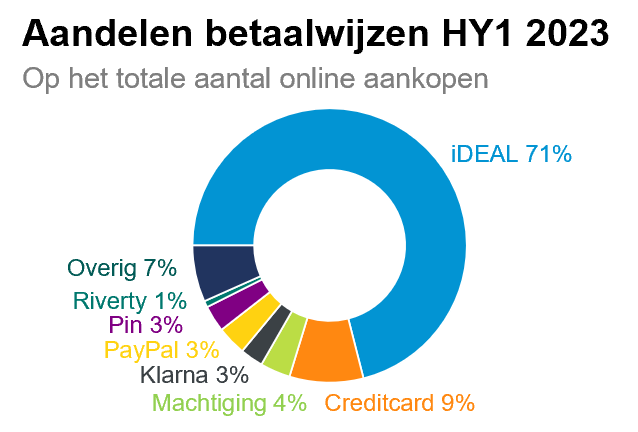
The number of purchases made via smartphone continues to rise, from 33% in the first half of 2022 to 35% in the first half of 2023. This is at the expense of the number of purchases made via tablet (from 13% to 12%) and desktop/laptop (from 52% to 51%). iDEAL is growing in terms of online spending (from 61% to 62%) and the number of online purchases (from 70% to 71%). Credit card use is rising in terms of both spending (from 14% to 15%) and purchases (from 8% to 9%), driven in particular by cross-border purchases. Klarna’s share is also continuing to grow: its share of online purchases has risen from 2% to 3%.
Related articles
-
A2A payments continue to grow
-
News
-
Online payments
-
-
Dutch abroad pay most with cards in Spanish hospitality
-
News
-
Card payments
-
-

High confidence in Dutch payment system
-
News
-
Card payments
-
-
Next Phase of iDEAL Migration to Wero Begins in October
-
News
-
Online payments
-
-

Lower travel spending is putting pressure on overall online spending
-
News
-
Online payments
-
-

The Digital Euro and Stablecoins: Apples and Oranges
-
News
-
European legislation
-