
Contactless payments surge during COVID-19
As a result of the COVID-19 pandemic, many people in the Netherlands began paying for purchases at the checkout contactlessly with a debit card or mobile phone. This came at the expense of both cash and traditional debit card payments, where the card is inserted into the payment terminal.

After an exceptionally sharp fall in the share of cash payments during the first lockdown, consumers have paid with cash more often again since the summer, but still much less than before the pandemic. This is shown by joint studies by De Nederlandsche Bank and the Dutch Payments Association, and by research from the European Central Bank .
Dutch consumers use less cash than at the start of 2020
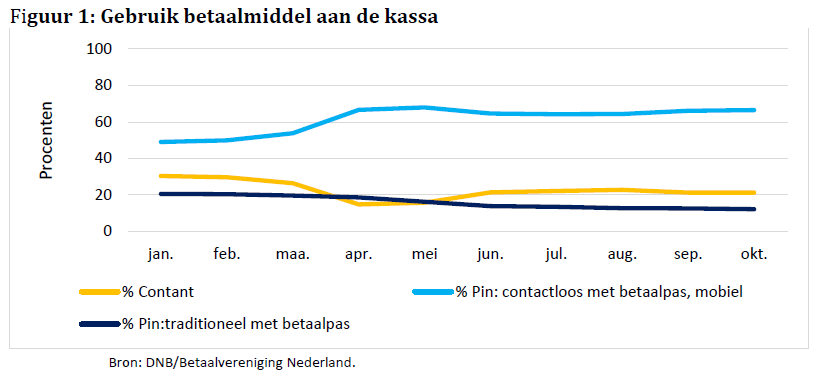
Since June, Dutch consumers have paid for around 20% of their point-of-sale purchases in cash (Figure 1). This is much lower than in January and February, when they paid for 30% of purchases in cash, but higher than immediately after the COVID-19 outbreak in the Netherlands, when cash accounted for only 15% of purchases in April.
In October, consumers paid for 67% of their point-of-sale purchases contactlessly, compared with only half at the start of the year. This increase did not come at the expense of cash alone. Traditional debit card payments also declined during the preceding months. Consumers still paid for 21% of purchases by inserting their card at the start of 2020, but for only 12% in October.
COVID-19 had the greatest effect on older people and the smallest on people with a low income
After a very sharp dip in April, people with a gross household income of up to €23,400 now pay for their purchases in cash almost as often as at the start of 2020. They paid for 41% of their purchases in cash in February and 39% in October. Their use of cash may be related to a desire to retain control over spending. The pandemic had the strongest effect on cash use among people aged 65 and over. Whereas they still paid for almost half of their purchases in cash in February, this fell to one quarter in October. Their share of contactless debit card payments more than doubled, from 27% in February to 58% in October.
Different reasons for paying with cash less often
Of the people in the Netherlands who pay with cash less often because of COVID-19, 37% say that some retailers no longer accept cash or discourage its use. Almost as many say they were guided by supposed government advice (36%). This is striking because the Dutch government has stated since the start of the COVID-19 crisis that consumers can still pay with cash. Fear of infection through banknotes and coins, or through hand contact with the retailer, also played a role in paying with cash less often (29% for each reason). This was despite the National Institute for Public Health and the Environment (RIVM) stating that the risk of infection from touching products or surfaces, including cash, is very small. Almost 30% also say they use cash less often because electronic payments have been made easier. They are probably referring to banks raising the limits for contactless payments without a PIN.
Dutch consumers expect to keep paying electronically more often
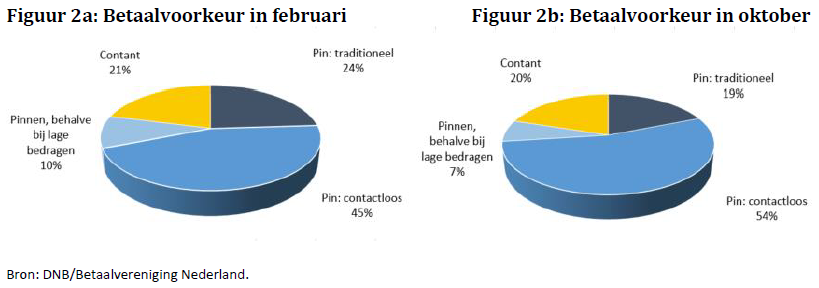
Of the Dutch respondents who have paid with cash less often since the COVID-19 crisis, 39% are certain they will continue to pay electronically more often and 43% consider this likely. Older people are relatively strongly represented among them. The shift consumers expect in their payment behaviour is consistent with the changing payment preferences they reported. Throughout 2020, a growing share of people in the Netherlands expressed a preference for contactless payments: in February, 45% preferred to pay contactlessly for all checkout purchases, rising to 54% six months after the COVID-19 outbreak. Contactless payments gained particular favour among people who had initially preferred traditional debit card payments, whose share fell from 24% to 19%, and among those who already preferred debit cards but used cash for small amounts, whose share fell from 10% to 7%. As more than half of all checkout payments are for amounts of up to €15, this latter shift in payment preference is helping the accelerated decline in cash use to persist. The share of consumers who generally prefer cash declined only slightly, from 21% to 20%. This fall is modest compared with the sharp decline in cash use because consumers who prefer cash also began paying by debit card more often.
Despite the decline in cash use, it remains important to maintain high levels of cash acceptance by retailers and access to facilities for withdrawing and depositing cash. Although almost eight in ten people in the Netherlands prefer to pay electronically at the checkout, almost half say it is important to be able to pay with cash.
Read the full factsheet:
Related articles
-
Dutch abroad pay most with cards in Spanish hospitality
-
News
-
Card payments
-
-
Tackling ATM attacks with ink, glue and synthetic DNA
-
News
-
Cash payments
-
-

High confidence in Dutch payment system
-
News
-
Card payments
-
-
Make digital euro useful, simple and affordable
-
News
-
European legislation
-
-
Cash accepted at 96% of points of sale
-
News
-
Cash payments
-
-
Vote on the Design of New Euro Banknotes
-
News
-
Cash payments
-