
What are banks doing to counter DDoS attacks?
In recent days, the websites of Dutch banks have repeatedly been bombarded with large volumes of data traffic. The banks are taking defensive measures to keep their services as widely available as possible.

Despite these measures, the attacks may still cause temporary, limited disruptions at one or two banks at a time. A DDoS attack does not put the security of customer or account data at risk.
Ongoing battle against attackers
Banks are engaged in an ongoing battle against DDoS attackers. They can usually repel the attacks effectively, so customers notice nothing. To achieve this, banks continually improve their defensive techniques and try to stay ahead of new attacks. The attacks of recent days, however, appear to be much larger and more complex than previous attacks.
Cooperation
In their efforts to counter DDoS attacks, banks work closely with one another and with the authorities, including De Nederlandsche Bank. Several consultation structures have been established for situations like these, with the aim of restoring payments to normal as quickly as possible.
Finance Minister Wopke Hoekstra said the following on Monday, 29 January:
- Every DDoS attack that causes disruption is very inconvenient for consumers. Fortunately, bank systems repel most attacks and they do not cause any disruption.
- The security of payments and customer data is not at risk during an attack. Disruptions may, however, temporarily prevent consumers from accessing their money online.
- Banks affected by a DDoS attack do everything possible to resolve the problems as quickly as possible.
- The Ministry is in contact with DNB about the DDoS attacks of recent days. DNB is in contact with the banks, which are responsible for protecting banking data and securing their systems, and work on this continuously.
- The security and protection of banking data is a priority for the sector, the supervisory authorities and me personally. The parties work closely with one another and with other partners, such as the National Cyber Security Centre of the National Coordinator for Security and Counterterrorism, to identify cyber threats and limit cyberattacks.
- The financial sector is one of the Netherlands’ vital sectors and therefore has our full attention.
What is a DDoS attack?
In a DDoS attack, a website is bombarded with extremely large volumes of data traffic from many different sources. This overloads the web servers, making the website difficult or impossible to access temporarily.
Beware of fraudulent emails
Related articles
-
Pay-by-Bank, what is it?
-
News
-
Online payments
-
-
A2A payments continue to grow
-
News
-
Online payments
-
-

The Payments Association at GDC26: digital identity and payments
-
News
-
Digital identity
-
-

High confidence in Dutch payment system
-
News
-
Card payments
-
-

Industry organisations: involve the financial sector in the roll-out of digital wallets
-
News
-
Digital identity
-
-
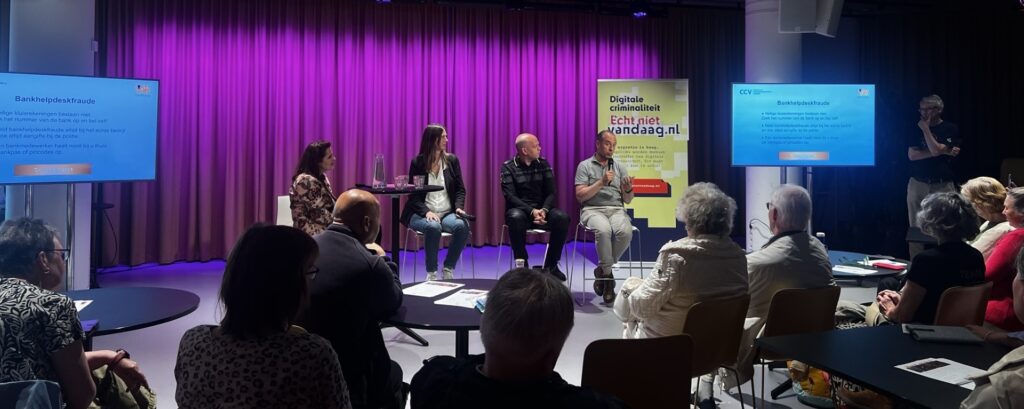
Digital Resilience and AI
-
News
-
Digital identity
-