
Online banking fraud falls by more than half
Losses caused by online banking fraud fell by 58% in the first half of 2013 compared with the second half of 2012.
The amount involved fell from €10 million to €4.2 million. Compared with the same period last year, the decline was even larger at 82%.
Skimming losses also fell, from €10.8 million in the second half of 2012 to €5.9 million now, a decrease of 45%.
Dutch Banking Association (in Dutch) Chair Chris Buijink says the decline is good news but does not mean that anyone can become complacent: “After years of sometimes exponential increases, the trend is now downward, which we are of course pleased about. This is thanks to the joint efforts of banks, retail organisations, the police and the justice system, and to customers’ vigilance. Nevertheless, criminals continue to look for ways to obtain money. Banks are therefore doing everything possible to prevent fraud and explain to customers how to bank securely.”
Online banking fraud
Banks still see many attempted fraud cases. Criminals use malware, specialised software that infiltrates customers’ computers, and phishing, which attempts to obtain confidential information. However, losses are falling as banks become better at identifying and preventing fraud. Secure banking campaigns have also made consumers more aware of criminals’ methods, so they are less likely to be deceived.
Banks also work closely with the Public Prosecution Service and the police in the Electronic Crimes Task Force (ECTF).
No money was stolen during the series of DDoS attacks that caused considerable public concern this spring, because the criminals could not access funds. There have been no successful cyberattacks since April.
Around 93% of credit transfers are now made online. Eleven million customers use online banking, and almost four out of five people in the Netherlands aged 16 to 75 manage their banking online. The proportion of older people aged 55 to 75 using online banking has doubled since 2005 to 60%, according to Statistics Netherlands. Among Europeans, people in the Netherlands and Finland use online banking most often.
Skimming
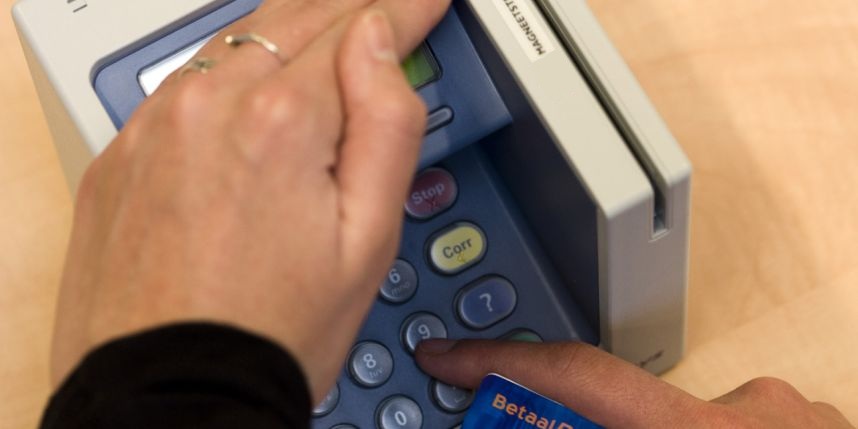
The decline in skimming losses is mainly the result of geoblocking, which disables the magnetic stripe on debit cards outside Europe by default. Since the introduction of the EMV chip in 2012, it had already become virtually impossible to withdraw cash with skimmed cards in Europe. The EMV chip means that payment terminals in staffed retail environments, particularly shops and hospitality venues, are no longer attacked. To further prevent skimming at ATMs and unattended payment terminals in the parking and petrol sectors, banks and the Dutch Payments Association took additional measures in the first half of 2013, making skimming increasingly rare.
A list of articles
-

Pay-by-Bank, what is it?
-
News
-
Online payments
-
-
A2A payments continue to grow
-
News
-
Online payments
-
-

Your bank is always nearby!
-
News
-
Payments for all
-
Related articles
-
Pay-by-Bank, what is it?
-
News
-
Online payments
-
-
A2A payments continue to grow
-
News
-
Online payments
-
-

The Payments Association at GDC26: digital identity and payments
-
News
-
Digital identity
-
-

High confidence in Dutch payment system
-
News
-
Card payments
-
-

Industry organisations: involve the financial sector in the roll-out of digital wallets
-
News
-
Digital identity
-
-
Digital Resilience and AI
-
News
-
Digital identity
-