
Online banking fraud continues to fall
Losses caused by online banking fraud fell further in 2015, from €4.7 million in 2014 to €3.7 million in 2015.
Phishing was the largest source of online banking fraud losses, accounting for €3 million. Banks reimbursed the losses in almost every case. Of the €3.7 million, only €40,000 (1.1%) was not reimbursed because the loss was attributable to gross negligence by the customer.
Total payment fraud losses amounted to €17.9 million, a slight increase from €17.3 million in 2014. Since 2012, total losses had fallen from €81.8 million in 2012 and €33.3 million in 2013 to just over €17 million a year in each of the previous two years. Newer developments such as mobile banking and contactless payments had not yet resulted in any fraud losses.
Chart: payment fraud losses
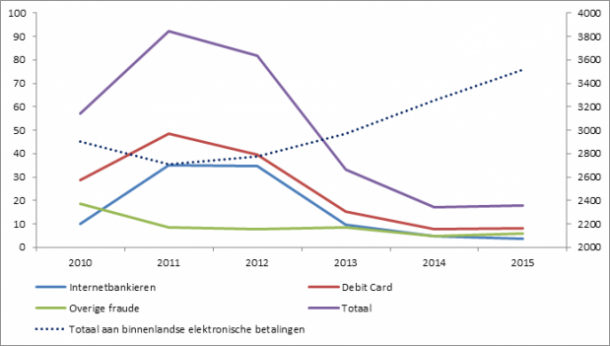
Right-hand scale: total domestic electronic payments in billions of euros per year.
Cooperation
The decline in online banking fraud losses shows that banks are becoming increasingly successful at detecting fraud in time. Banks also work closely with government bodies to keep payments secure. Knowledge and information are shared within the National Cyber Security Centre (NCSC), the public-private partnership for preventing online fraud. Within the Electronic Crime Task Force (ECTF), which celebrated its fifth anniversary that year, banks work with the police and the Public Prosecution Service to identify and prosecute cybercriminals.
Debit card forwarding fraud
Losses caused by stolen or lost debit cards rose from €3.3 million to €4.7 million in 2015. This was due to a new type of fraud in which criminals used false pretences to persuade cardholders to send in their debit card. Banks will never ask customers to send their card or disclose their PIN. Bank customers were actively warned about this through the Veilig Bankieren campaign ‘Hang up! Click away! Call your bank!’: ‘Never send your debit card!’
Skimming
Following the introduction of the EMV chip and the standard blocking of debit cards for use outside Europe (geoblocking), skimming had accounted for a relatively small share of fraud losses for several years. In 2015, these losses amounted to €1.7 million. Skimming losses had almost disappeared in the Netherlands. Most losses arose because cards were skimmed outside Europe when geoblocking was not active. These losses were expected to fall further as countries outside Europe also adopted the EMV chip instead of the magnetic stripe.
Related articles
-

Dutch abroad pay most with cards in Spanish hospitality
-
News
-
Card payments
-
-

The Payments Association at GDC26: digital identity and payments
-
News
-
Digital identity
-
-

High confidence in Dutch payment system
-
News
-
Card payments
-
-

Industry organisations: involve the financial sector in the roll-out of digital wallets
-
News
-
Digital identity
-
-

Checking In and Out on Public Transportation Is Now Even Smoother with Your Smartphone
-
News
-
Card payments
-
-

More travelers very satisfied about traveling with payment card
-
Press release
-
Card payments
-