
DNBulletin: debit card share at points of sale exceeds 60 per cent
Over the past six months, consumers paid for 61 per cent of their purchases at shops, petrol stations, hospitality venues and other points of sale by debit card, and 39 per cent in cash.
This means the target of 60 per cent debit card and 40 per cent cash payments has been reached. Banks and retail organisations agreed this target in 2014, when 60 per cent of payments were still made in cash and 40 per cent by debit card. The figures come from joint research by the Dutch Payments Association and De Nederlandsche Bank into how consumers pay at points of sale. The agreements to promote the use of debit cards were made at the time under the Payments Covenant in order to increase the security and efficiency of payments.
Debit card share reached 60 per cent for the first time in May 2018
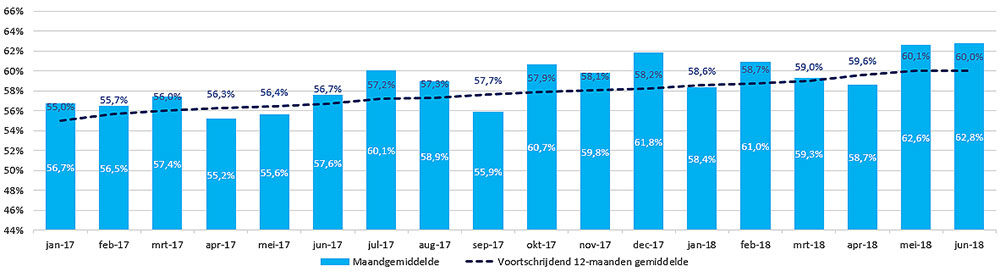
In May, consumers paid for an average of 60 per cent of their point-of-sale purchases by debit card and 40 per cent in cash over a twelve-month period for the first time. This officially achieved the target of the Payments Covenant. Although consumers had already paid for 60 per cent or more of their point-of-sale purchases by debit card at times in 2017, the full-year average of 58.1 per cent was still below the target. Including the June figure, 61 per cent of purchases in the first half of 2018 were paid for by debit card and 39 per cent in cash. Figure 1 shows both the monthly average and the rolling twelve-month average for the share of debit card payments at points of sale.
Debit card use highest among 19- to 24-year-olds
Although most population groups use debit cards more often than cash, there are clear differences (Figure 2). Young people aged 19 to 24 lead the Netherlands in debit card use. During the first six months of 2018, they paid for 77 per cent of their purchases by debit card and 23 per cent in cash. The increase in debit card use was also by far the strongest in this group, rising by nine percentage points compared with the first half of 2017. Women, people aged 55 to 64, people with secondary education and university graduates also paid by debit card significantly more often over the past year, up four percentage points. Among 25- to 34-year-olds and people with a lower level of education, the increase was limited to less than one percentage point.
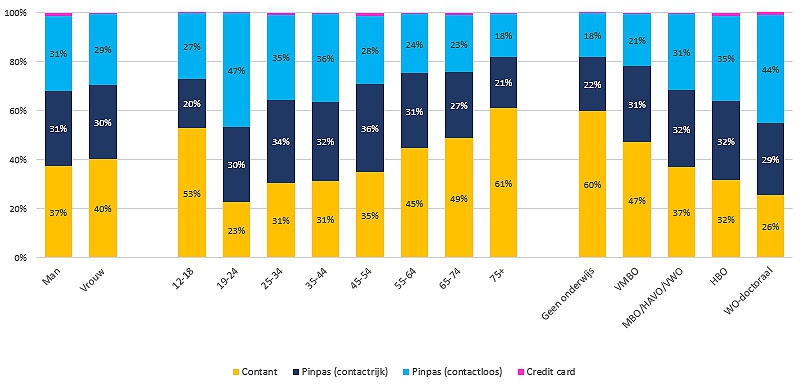
The introduction of contactless payments in 2014 helped drive the growth in debit card use. Consumers now make approximately half of all their debit card payments contactlessly, on average. This represents three in ten of all purchases. People aged 19 to 24 pay contactlessly most often, for almost half of their purchases. People aged 75 and over and those with a lower level of education do so least often, but they too already make almost one in five purchases contactlessly.
Debit card payments overtake cash in hospitality for the first time
The use of debit cards and cash still depends strongly on the market segment (Figure 3), although the differences are becoming smaller. Debit cards are now used more often than cash in seven of the twelve market segments studied. In the first half of 2018, hospitality showed a higher share of debit card than cash payments for the first time. Growth in debit card payments over the past year was strongest in this segment, rising by seven percentage points compared with the first half of 2017, followed by non-food retail at five percentage points and street vendors at four percentage points.
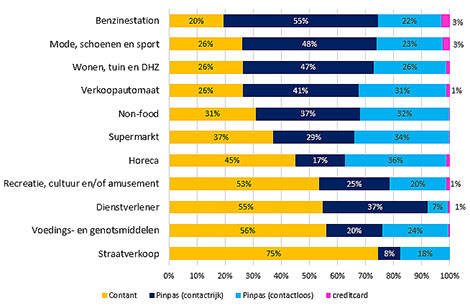
Hospitality and street vending are market segments in which consumers traditionally paid mainly in cash because of the low amounts and because debit card acceptance was not widespread for a long time. The arrival of mobile payment terminals, combined with contactless payments, has led to rapid growth in debit card use in these segments. Over the past six months, consumers in hospitality and at street vendors made twice as many contactless debit card payments as chip-and-PIN payments.
Related articles
-
Dutch abroad pay most with cards in Spanish hospitality
-
News
-
Card payments
-
-
Tackling ATM attacks with ink, glue and synthetic DNA
-
News
-
Cash payments
-
-

High confidence in Dutch payment system
-
News
-
Card payments
-
-
Make digital euro useful, simple and affordable
-
News
-
European legislation
-
-
Cash accepted at 96% of points of sale
-
News
-
Cash payments
-
-
Vote on the Design of New Euro Banknotes
-
News
-
Cash payments
-