
Half of Dutch businesses order products online
B2B e-commerce is on the rise. The share of the working population that had placed or approved an online business order in the preceding twelve months increased by nine percentage points year on year to 48%.
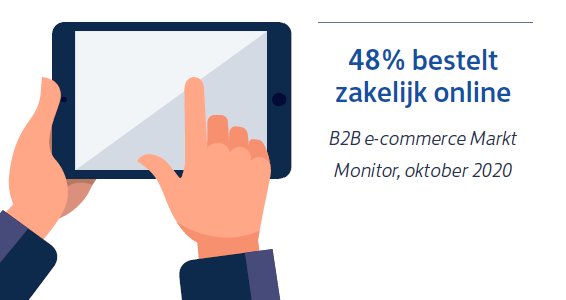
Office supplies and computers remain popular categories, but larger and more specialised products are also frequently bought online. This is shown by the B2B E-commerce Market Monitor 2020 published today, a large-scale study of the behaviour and preferences of business online shoppers. Multiscope surveyed 3,899 Dutch employees on behalf of Thuiswinkel.org , PostNL , De Nieuwe Zaak and Currence .
“As with consumers, we are now seeing a sharp rise in the number of business online shoppers over the past year,” says Wijnand Jongen, CEO of Thuiswinkel.org. “Although the impact of the COVID-19 crisis was not investigated explicitly, it is likely to have played a role, partly because the study shows that online orders gained share in many product categories.”
Role of digital grows in the B2B sector
Online orders gained share in most B2B industries. The strongest growth was seen in construction, where 60% of purchasers had placed at least one online order in the preceding twelve months, compared with 44% in 2019. Construction thus overtook business services as the industry with the highest share of online purchasers. Hospitality and trade were among the other industries recording strong growth.
As in the previous year, business online purchasers mainly ordered office supplies and computers online. It is notable that large and more specialised goods were also frequently ordered online in 2020. Almost half of all purchasers ordered raw materials and semi-finished products online. Nearly one third ordered machinery and installations exclusively online, compared with one quarter a year earlier. Digital channels are playing a growing role in the supply chain.
Business buying experience better than expected
B2B customer experience is often perceived as lagging behind the B2C sector. However, more than 70% of business purchasers say their buying experience is the same as that of consumers, while almost one quarter have an even better experience when buying for business. Convenience is playing an increasingly important role in online ordering, through personalised offers, the payment process and the way orders are delivered.
Invoice and iDEAL are the preferred payment methods
When asked about their preferred payment method for an online business order, 38% of respondents chose payment by invoice and 36% payment through iDEAL . Credit cards followed at a considerable distance with 9%, AfterPay with 5% and PayPal with 4%.
There is a difference between the method business purchasers prefer and the one they use most often. Some 40% say that their most frequently used method is not their preferred method. In practice, 26% pay by invoice and 50% with iDEAL. The main reasons for these differences are the options offered by the seller and the policy applied within the purchaser’s company. Despite the difference between preference and actual use, business online purchasers are generally satisfied with the payment options available: 67% are satisfied or very satisfied.
61% compare online shops on logistics
Logistics play a decisive role in the growth of B2B e-commerce. Some 61% of business online purchasers compare aspects such as delivery speed, the locations to which delivery is available and shipping costs. Other important delivery factors are low delivery costs and the ability to track the product. Almost one third of business online purchasers consider these important. Return options also matter: 77% let return conditions influence their choice of online shop, while 20% abandon an order if returns are not possible. This is striking because, unlike the B2C sector, the B2B sector has no statutory right of return.
Although sustainability is not among the five most important delivery factors for everyone, more than one third (37%) of business online purchasers consider sustainable delivery important to some extent. For 34%, this may come at the expense of delivery speed, while 18% would be willing to pay slightly more. Light users are more willing to wait longer for sustainable delivery (38%) than heavy users (20%).
Related articles
-
Pay-by-Bank, what is it?
-
News
-
Online payments
-
-
A2A payments continue to grow
-
News
-
Online payments
-
-
Dutch abroad pay most with cards in Spanish hospitality
-
News
-
Card payments
-
-

High confidence in Dutch payment system
-
News
-
Card payments
-
-
Next Phase of iDEAL Migration to Wero Begins in October
-
News
-
Online payments
-
-

Lower travel spending is putting pressure on overall online spending
-
News
-
Online payments
-